

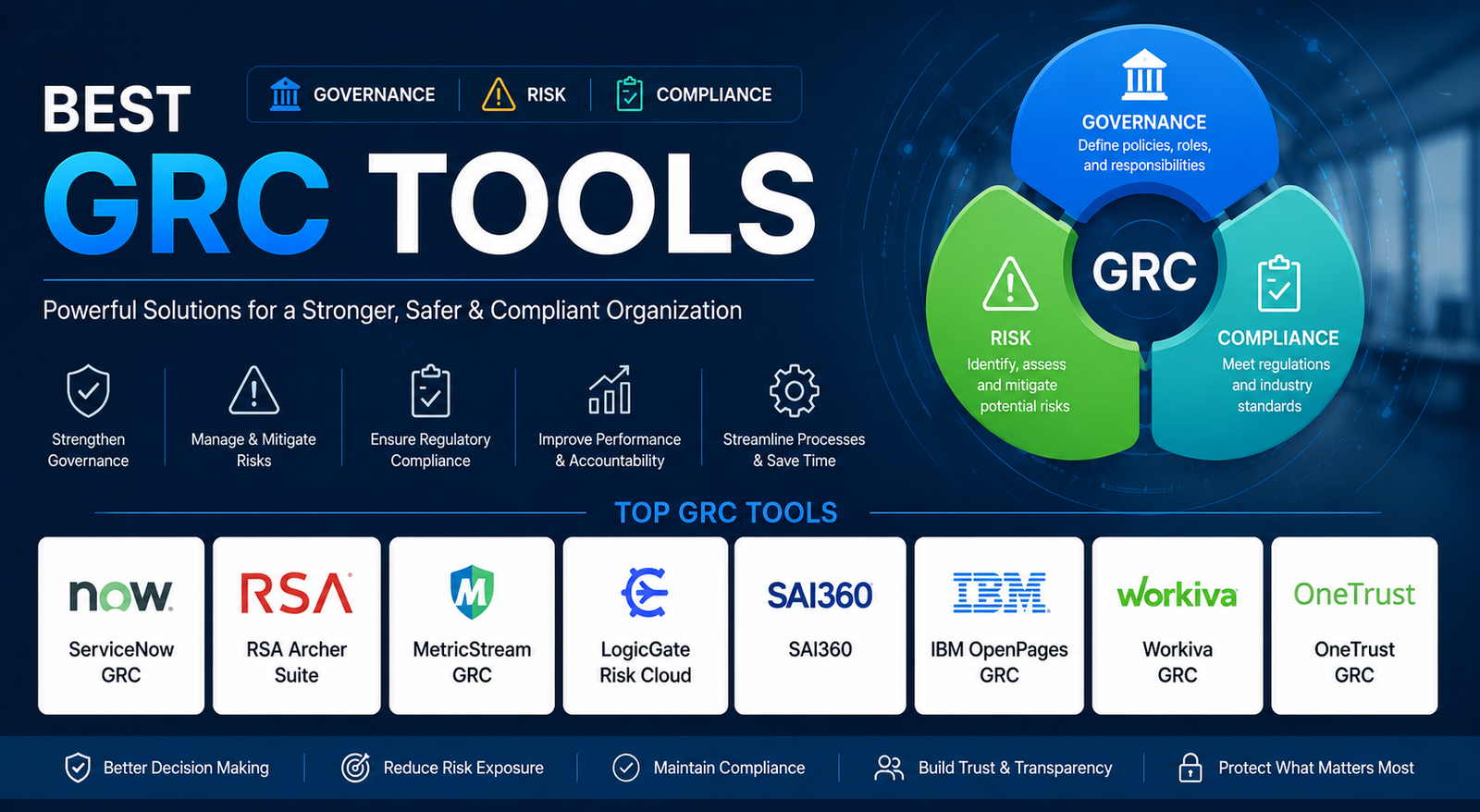
Managing governance, risk, and compliance has become more challenging as businesses face stricter regulations, increasing cyber threats, and growing operational complexity. Relying on spreadsheets or disconnected processes is no longer enough. Modern Governance, Risk, and Compliance (GRC) software helps organisations centralise risk management, automate compliance tasks, and improve decision-making while reducing manual effort.
If you're searching for the Best GRC Tools, this guide compares the leading platforms available in 2026. Whether you're a startup, a growing business, or a global enterprise, you'll discover the features, strengths, pricing considerations, and ideal use cases for each solution. We'll also explore AI-powered capabilities, compliance frameworks, and practical tips to help you choose the right platform for your organisation.
What Are GRC Tools?
Governance, Risk, and Compliance (GRC) tools are software platforms designed to help organisations manage policies, identify risks, meet regulatory requirements, and maintain operational transparency from a single dashboard.
Instead of handling governance, risk assessments, audits, and compliance activities separately, a GRC platform brings them together into one integrated system. This improves collaboration across departments while reducing administrative work and ensuring consistent compliance.
How GRC Software Works
A typical GRC platform allows organisations to:
Track business risks
Manage policies and procedures
Perform internal audits
Monitor regulatory compliance
Automate evidence collection
Generate reports for stakeholders
Manage third-party and vendor risks
Improve incident response
For example, a healthcare provider can use one GRC solution to monitor HIPAA compliance, perform vendor risk assessments, and prepare audit reports without switching between multiple tools.
Why Businesses Need GRC Software in 2026
Regulatory requirements continue to evolve, while cyberattacks, supply chain risks, and data privacy concerns grow more complex. Businesses need a proactive approach rather than reacting to compliance issues after they occur.
Modern GRC software enables organisations to identify risks early, automate repetitive compliance tasks, and maintain continuous visibility across departments.
Key benefits include:
Reduced compliance costs
Improved risk visibility
Faster audit preparation
Better decision-making
Stronger cybersecurity governance
Automated workflow management
Easier reporting for executives
Continuous monitoring of controls
Organisations pursuing certifications such as ISO 27001 or SOC 2 can significantly reduce preparation time by using automated evidence collection and policy management features.
How We Evaluated the Best GRC Tools
To ensure this guide is objective and valuable, every platform was assessed using consistent evaluation criteria rather than marketing claims.
Our evaluation focused on:
Governance capabilities
Enterprise risk management
Compliance automation
Audit management
Vendor risk management
Workflow automation
AI-powered features
Ease of implementation
User experience
Integration options
Reporting and dashboards
Scalability
Customer support
Overall value for money
This balanced approach helps organisations compare solutions based on real business needs rather than vendor popularity alone.
Quick Comparison of the Best GRC Tools
10 Best GRC Tools Reviewed
MetricStream
MetricStream is one of the most recognised enterprise GRC platforms, offering comprehensive governance, risk, compliance, and audit management capabilities. It is designed for large organisations managing multiple regulations across global operations.
Key Features
Enterprise risk management
Policy management
Internal audit automation
Third-party risk management
AI-powered analytics
Regulatory change management
Pros
Highly scalable
Extensive compliance library
Advanced reporting
Strong workflow automation
Cons
Premium pricing
Longer implementation process
Best For
Large enterprises with complex regulatory environments.
ServiceNow GRC
Among the most popular GRC tools ServiceNow offers, this platform integrates governance and compliance directly with IT operations. Organisations already using ServiceNow benefit from seamless workflows and centralised risk management.
Key Features
Policy lifecycle management
Continuous control monitoring
Operational risk management
IT compliance automation
Vendor risk tracking
Pros
Excellent integrations
Strong automation
Unified IT workflows
Cons
Learning curve for new users
Can require significant configuration
Best For
Businesses looking to connect governance and compliance with IT service management.
LogicGate
LogicGate is known for its flexible no-code workflow builder, allowing organisations to customise governance and compliance processes without extensive development work.
Key Features
Custom workflows
Risk assessments
Audit tracking
Vendor management
Compliance dashboards
Pros
User-friendly interface
Highly configurable
Fast deployment
Cons
Some advanced features require higher-tier plans
Best For
Mid-sized organisations seeking workflow flexibility.
IBM OpenPages
IBM OpenPages combines artificial intelligence with enterprise risk management to deliver powerful compliance monitoring and predictive analytics.
Key Features
AI-powered risk insights
Operational risk management
Regulatory compliance
Audit management
Business continuity planning
Pros
Enterprise-grade security
Advanced AI capabilities
Flexible deployment options
Cons
Higher implementation complexity
Best For
Large regulated industries such as banking, insurance, and healthcare.
Archer
Archer is a mature GRC platform widely adopted by enterprises that require comprehensive governance and risk management.
Key Features
Enterprise risk management
Third-party risk
Business resilience
Regulatory compliance
Incident management
Pros
Comprehensive functionality
Strong reporting
Mature platform
Cons
Interface feels dated compared to newer competitors
Best For
Large organisations with sophisticated governance requirements.
Hyperproof
Hyperproof simplifies compliance management by automating evidence collection and reducing repetitive manual tasks.
Key Features
Continuous compliance monitoring
Evidence collection
Audit readiness
Risk tracking
Collaboration tools
Pros
Easy implementation
Excellent user experience
Strong automation
Cons
Limited enterprise customisation
Best For
Growing businesses seeking efficient compliance management.
AuditBoard
AuditBoard focuses on internal audit, risk management, and compliance collaboration.
Key Features
Internal audits
Risk assessments
SOX compliance
Issue management
Executive reporting
Pros
Excellent audit workflows
Intuitive interface
Strong collaboration
Cons
Primarily audit-focused
Best For
Internal audit and assurance teams.
OneTrust
OneTrust is recognised for privacy, governance, and regulatory compliance management, making it especially valuable for organisations managing global privacy laws.
Key Features
Privacy management
Vendor risk
Third-party assessments
Policy management
Regulatory intelligence
Pros
Comprehensive privacy capabilities
Strong automation
Global compliance support
Cons
Premium pricing
Best For
Organisations managing GDPR and international privacy regulations.
Drata
Drata automates compliance processes for cloud-first businesses and SaaS companies.
Key Features
Automated evidence collection
Continuous monitoring
SOC 2 automation
ISO 27001 support
Cloud integrations
Pros
Rapid implementation
Excellent automation
Startup-friendly
Cons
Less suitable for highly complex enterprise governance
Best For
Startups and fast-growing SaaS businesses.
Vanta
Vanta helps organisations achieve compliance certifications through automation and continuous monitoring.
Key Features
Compliance automation
Employee security tracking
Policy management
Cloud integrations
Audit preparation
Pros
Simple deployment
Excellent onboarding
User-friendly interface
Cons
Limited advanced enterprise governance features
Best For
Small and medium-sized businesses pursuing compliance certifications.
Feature Comparison Matrix
Best GRC Tools by Business Size
Best for Startups
Startups often need affordable, cloud-based solutions that automate compliance without requiring dedicated compliance teams. Drata and Vanta are excellent choices because they simplify SOC 2, ISO 27001, and other certification processes while integrating with popular cloud services.
Best for Small Businesses
Small businesses benefit from platforms that balance functionality with ease of use. Hyperproof and LogicGate provide intuitive interfaces, automation, and scalable pricing, making them ideal for organisations with limited IT resources.
Best for Mid-Sized Companies
Mid-sized businesses require solutions that can grow alongside expanding compliance obligations. ServiceNow GRC, AuditBoard, and LogicGate offer advanced workflow automation, reporting, and collaboration features without the complexity of some enterprise-only platforms.
Best Enterprise GRC Platforms
Large enterprises often manage multiple business units, international regulations, and sophisticated risk programmes. MetricStream, IBM OpenPages, Archer, and OneTrust provide enterprise-grade scalability, advanced analytics, and comprehensive governance capabilities suitable for complex global operations.
Best GRC Tools by Industry
Different industries have unique compliance requirements, so choosing a platform that aligns with your regulatory landscape is essential.
Healthcare
Healthcare organisations should prioritise tools that support HIPAA, patient data protection, vendor risk management, and continuous compliance monitoring. MetricStream and OneTrust are strong choices for managing sensitive healthcare environments.
Financial Services
Banks, insurers, and financial institutions benefit from enterprise platforms like IBM OpenPages and Archer, which support operational risk, regulatory reporting, fraud management, and internal controls.
SaaS and Technology
Fast-growing SaaS businesses often require automation for SOC 2, ISO 27001, and cloud security. Drata and Vanta streamline evidence collection and reduce manual compliance work.
Manufacturing
Manufacturers need operational risk management, supplier governance, and business continuity planning. ServiceNow GRC and MetricStream provide robust workflows for complex operations.
Government and Public Sector
Government agencies typically require extensive audit trails, policy management, and compliance with frameworks such as NIST. IBM OpenPages and Archer are well suited for these highly regulated environments.
AI-Powered GRC Software: The Future of Compliance
Artificial intelligence is transforming Governance, Risk, and Compliance by helping organisations identify risks faster and automate repetitive tasks.
Modern AI-powered GRC platforms can:
Detect compliance gaps automatically
Predict potential risks using historical data
Automate evidence collection
Recommend policy improvements
Generate executive reports
Continuously monitor regulatory changes
Prioritise high-risk incidents
Rather than replacing compliance professionals, AI enables teams to focus on strategic decision-making while reducing administrative workloads.
Compliance Frameworks Supported by Leading GRC Platforms
Choosing software that supports your required frameworks reduces manual work and simplifies audits.
Open Source and Free GRC Tools
Many organisations begin by exploring Open source GRC tools before investing in enterprise platforms.
Free solutions can be suitable for:
Small businesses
Educational institutions
Early-stage startups
Organisations with limited compliance requirements
However, open-source platforms often lack:
Enterprise support
AI automation
Continuous monitoring
Advanced reporting
Vendor risk management
Regulatory updates
As compliance requirements grow, organisations usually migrate to commercial platforms offering broader automation and ongoing support.
Key Features to Look for in a GRC Platform
Before selecting software, evaluate the features that will have the greatest long-term impact.
Important capabilities include:
Enterprise risk management
Policy lifecycle management
Compliance automation
Internal audit management
Vendor risk assessment
Business continuity planning
Workflow automation
Custom dashboards
AI-assisted reporting
Regulatory change management
API integrations
Role-based access control
Document management
Incident tracking
Selecting software with these capabilities helps reduce compliance costs while improving organisational resilience.
Common Challenges When Implementing GRC Software
Even the best software requires thoughtful implementation.
Common challenges include:
Migrating legacy data
Employee adoption
Integrating existing systems
Standardising compliance processes
Training internal teams
Defining ownership across departments
Successful implementation usually starts with a phased rollout, stakeholder involvement, and clearly defined governance policies.
How to Choose the Right GRC Tool
Every organisation has different priorities, so selecting the right platform requires evaluating both current and future needs.
Use the following checklist before making a decision.
Request product demonstrations, involve compliance teams early, and compare multiple vendors before making a final decision.
Common Mistakes to Avoid When Buying GRC Software
Many organisations purchase software based solely on features without considering long-term operational needs.
Avoid these common mistakes:
Choosing software based only on price
Ignoring scalability requirements
Overlooking integration capabilities
Failing to involve compliance stakeholders
Skipping proof-of-concept testing
Underestimating employee training
Not reviewing vendor support quality
Careful planning can significantly improve implementation success and return on investment.
GRC Software Pricing: What to Expect
Most vendors provide customised pricing based on organisational size and feature requirements.
Typical pricing models include:
Subscription-based licensing
Per-user pricing
Enterprise agreements
Usage-based pricing
Custom enterprise quotations
When evaluating costs, consider implementation, integrations, employee training, support, and future scalability rather than licence fees alone.
Conclusion
Choosing the best GRC tools depends on your organisation's size, industry, regulatory requirements, and long-term objectives. While enterprise organisations may benefit from platforms such as MetricStream, IBM OpenPages, or Archer, growing businesses often prefer flexible and automation-focused solutions like LogicGate, Hyperproof, Drata, or Vanta.
Evaluate each platform based on compliance framework support, AI capabilities, integration options, scalability, and implementation complexity. By selecting software that aligns with both current and future governance needs, your organisation can improve compliance, reduce operational risks, and build a stronger foundation for sustainable growth.
Frequently Asked Questions
What are the best GRC tools in 2026?
Some of the leading platforms include MetricStream, ServiceNow GRC, IBM OpenPages, Archer, LogicGate, Hyperproof, AuditBoard, OneTrust, Drata, and Vanta. These are frequently included in discussions about the Top 10 GRC tools because they offer strong governance, risk management, and compliance capabilities.
What are the Top 5 GRC tools for enterprise organisations?
Many enterprises consider MetricStream, IBM OpenPages, Archer, ServiceNow GRC, and OneTrust among the Top 5 GRC tools due to their scalability, automation, and comprehensive compliance features.
Does Gartner rank GRC platforms?
Yes. Many buyers research the Top GRC tools Gartner recommendations and review insights from the Gartner Magic Quadrant for governance, risk and compliance Tools, Assurance Leaders alongside independent product evaluations before making purchasing decisions.
Are there free or open-source GRC solutions?
Yes. Several Open source GRC tools are available for organisations with basic compliance needs. While they can reduce upfront costs, they generally provide fewer automation features and less vendor support than commercial platforms.
Where can I find unbiased user opinions on GRC software?
In addition to analyst reports and vendor documentation, many buyers explore discussions on community forums such as Best GRC tools Reddit to learn about real-world implementation experiences and user feedback.
Is ServiceNow a GRC platform?
Yes. GRC tools ServiceNow include modules for governance, operational risk, policy management, compliance, and continuous control monitoring, making it a popular choice for organisations already using the ServiceNow ecosystem.
Leave a Reply