

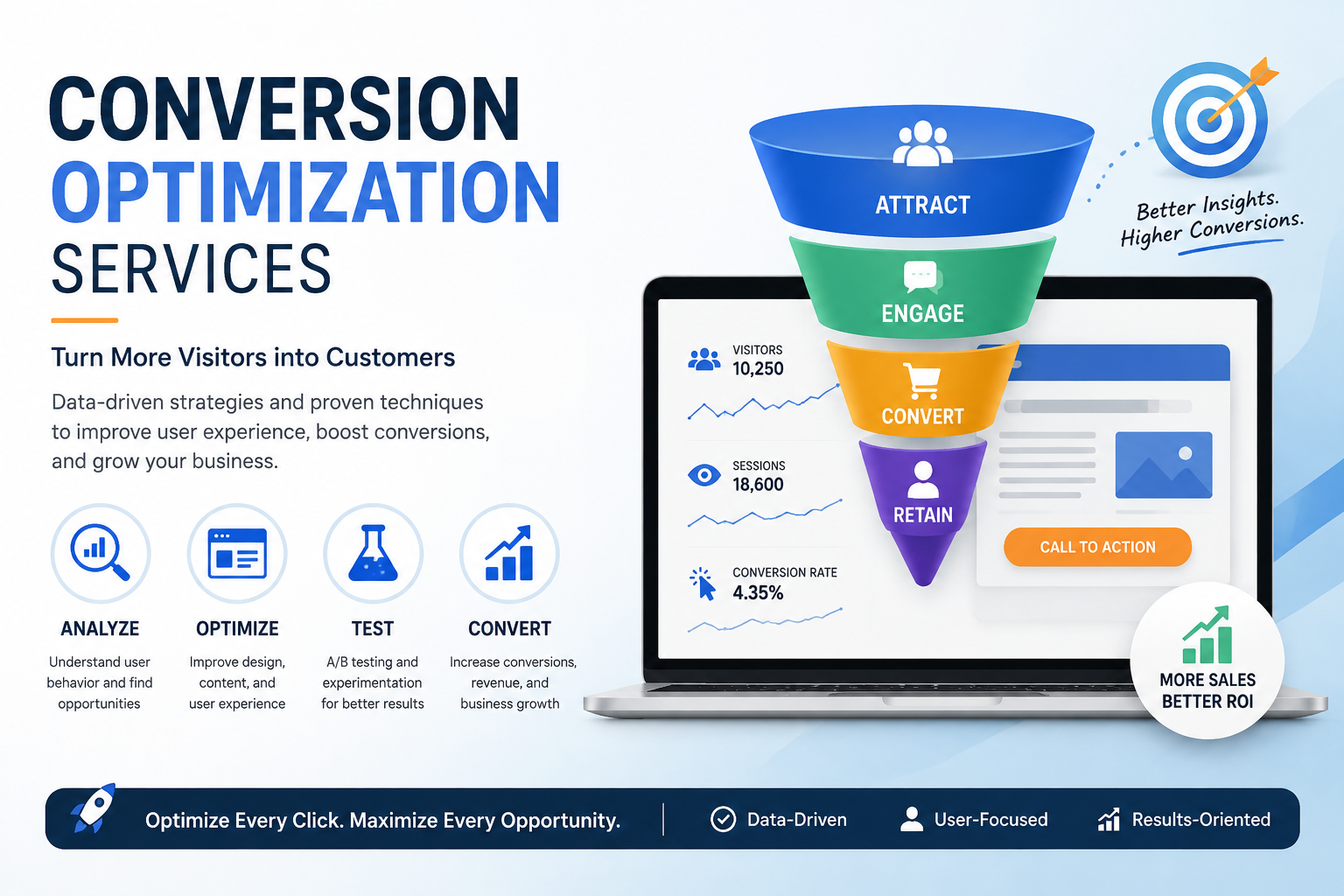
Getting more visitors to a website is only part of digital growth. If those visitors leave without buying, signing up, requesting a quote, or contacting your business, additional traffic may not solve the underlying problem. Conversion optimization services focus on improving what happens after visitors arrive.
Professional conversion rate optimization (CRO) combines website data, user research, UX improvements, persuasive messaging, funnel analysis, and experimentation to increase the percentage of visitors who complete valuable actions. The goal is not simply to make a website look better—it is to make the customer journey clearer, easier, and more effective.
Whether you run an ecommerce store, SaaS company, B2B website, or service business, CRO can help turn existing traffic into more measurable business results.
What Are Conversion Optimization Services?
Conversion optimization services are professional strategies and activities designed to increase the percentage of website visitors who complete a desired action. These actions can include making a purchase, submitting a form, booking an appointment, requesting a demo, or starting a free trial.
A CRO specialist typically examines analytics, user behavior, website usability, messaging, and conversion funnels to identify friction. Instead of guessing what might work, the process uses evidence to develop and test improvements.
For example, a SaaS website might receive 10,000 monthly visitors but only 150 demo requests. A CRO engagement could investigate why visitors hesitate, improve the demo page, simplify the form, and test alternative messaging.
What Do Conversion Optimization Services Include?
The exact scope varies by provider, but comprehensive conversion optimization services usually combine research, strategy, testing, UX, and performance analysis.
CRO Audits
A CRO audit examines the website from a conversion perspective. It can identify unclear calls to action, distracting navigation, weak value propositions, lengthy forms, technical problems, mobile usability issues, and funnel drop-off points.
Conversion Research
Research helps explain why users behave differently from what analytics alone reveal. Common methods include heatmaps, session recordings, surveys, customer interviews, funnel analysis, and competitor research.
Landing Page Optimization
Landing pages often have a direct relationship with lead generation and sales. CRO professionals may improve headlines, value propositions, CTA placement, trust signals, page structure, forms, and message consistency.
A/B Testing
A/B testing compares different versions of a page or element to determine which performs better against a defined objective. Strong experimentation starts with a research-backed hypothesis rather than randomly changing button colors or headlines.
UX and Website Optimization
Conversion optimization can involve improving navigation, mobile usability, information hierarchy, page speed, accessibility, and checkout experiences. Reducing unnecessary friction can make it easier for users to complete their intended action.
Conversion Copywriting
Copy influences whether visitors understand the offer and believe it is worth pursuing. CRO copywriting can address headlines, product descriptions, CTAs, objections, benefits, trust statements, and value propositions.
How Does the Conversion Optimization Process Work?
A professional CRO process should be systematic rather than based on isolated “conversion hacks.”
Define business goals: Determine whether the priority is sales, leads, signups, demos, revenue, or another measurable outcome.
Establish a baseline: Review current conversion rates and relevant business metrics.
Analyze data: Identify high-traffic pages, funnel drop-offs, user behavior, and performance problems.
Conduct user research: Use surveys, interviews, recordings, and behavioral data to understand customer concerns.
Identify opportunities: Determine which problems have the greatest potential business impact.
Create hypotheses: Form a specific, measurable explanation of what should change and why.
Prioritize experiments: Rank ideas according to impact, confidence, effort, and available data.
Run tests: Implement appropriate A/B or other controlled experiments.
Analyze results: Determine whether the change produced a meaningful improvement.
Iterate: Apply successful findings and use unsuccessful tests as learning opportunities.
A simple CRO workflow is:
Audit → Research → Hypothesis → Test → Analyze → Implement → Repeat
This continuous approach is important because customer expectations, products, traffic sources, and market conditions change over time.
Which Businesses Can Benefit From CRO Services?
CRO is not limited to online stores. Any website with a measurable conversion goal can potentially benefit.
Ecommerce Conversion Optimization
For ecommerce businesses, CRO may focus on product pages, search and navigation, cart abandonment, checkout friction, product information, reviews, shipping information, and trust signals.
For example, an online retailer with strong traffic but a high checkout abandonment rate might benefit more from simplifying checkout than from immediately spending more on advertising.
SaaS Conversion Optimization
SaaS companies often optimize free-trial registrations, demo requests, pricing pages, onboarding flows, and feature pages.
A SaaS business could test whether a clearer value proposition and shorter signup form increase trial registrations without reducing lead quality.
B2B Conversion Optimization
B2B websites frequently depend on high-value conversions such as demo requests, consultations, quote requests, and sales inquiries. CRO can improve messaging, forms, case studies, trust elements, and lead-generation pages.
Local and Service Businesses
For service companies, important conversions may include phone calls, appointment bookings, quote requests, or contact forms. Removing friction from these journeys can help businesses generate more opportunities from existing traffic.
CRO Services vs. Other Digital Marketing Services
Conversion optimization works alongside other marketing channels rather than necessarily replacing them.
A website can rank well and still convert poorly. Likewise, a paid campaign can generate thousands of visitors without producing enough customers. CRO helps maximize the value of traffic generated through SEO, PPC, social media, email, and other channels.
CRO Agency vs. Consultant vs. In-House Team
Choosing the right provider depends on budget, complexity, internal expertise, and how much ongoing execution is required.
An agency may be appropriate when a company needs research, strategy, testing, design, analytics, and ongoing experimentation. A consultant can be useful when the business already has internal implementation resources but needs strategic direction.
How Much Do Conversion Optimization Services Cost?
There is no universal price for CRO. Costs depend on website size, traffic volume, business model, research requirements, testing frequency, technical complexity, and the scope of the engagement.
Common pricing models include hourly consulting, fixed CRO audits, project-based optimization, and monthly retainers. Some providers may also offer performance-based arrangements.
Instead of comparing providers on price alone, compare the scope and expected deliverables. A low-cost package that only provides recommendations may be very different from an ongoing program that includes research, experiments, development, analytics, and reporting.
What Should Be Included in a CRO Services Package?
A strong CRO package should clearly explain what the client receives and how success will be measured.
Typical deliverables can include:
Initial CRO audit
Analytics review
User behavior research
Competitor analysis
Conversion funnel analysis
UX recommendations
Copy recommendations
Experiment roadmap
A/B test planning
Test implementation
Performance monitoring
Regular reporting
A provider should also explain which team handles development, design, analytics configuration, and implementation. Clear responsibilities prevent misunderstandings later.
How Do You Measure the ROI of CRO?
Conversion rate is important, but it should not be the only metric. Depending on the business, useful KPIs include revenue per visitor, average order value, lead-to-customer rate, cost per lead, checkout completion, trial-to-paid conversion, and customer acquisition cost.
Consider a website receiving 50,000 visitors per month with a 2% conversion rate:
50,000 × 2% = 1,000 conversions
If CRO increases the conversion rate to 2.5%:
50,000 × 2.5% = 1,250 conversions
That represents 250 additional conversions from the same traffic volume. The financial value depends on what each conversion is worth to the business.
How Long Does CRO Take to Show Results?
Some improvements can produce immediate benefits, particularly when a website has obvious usability or technical problems. However, meaningful experimentation often requires sufficient traffic, accurate tracking, proper test design, and time to gather reliable data.
CRO should generally be viewed as an ongoing optimization discipline rather than a one-time redesign. Early research may uncover quick wins, while continuous testing creates a longer-term learning system.
How to Choose the Right Conversion Optimization Service Provider
Look beyond attractive promises and focus on methodology, transparency, and relevant experience.
A strong CRO provider should be able to explain how it identifies opportunities, conducts research, develops hypotheses, prioritizes experiments, and reports results.
Before hiring a conversion optimization agency, ask:
What CRO research methods do you use?
How do you prioritize experiments?
What testing platforms do you work with?
Who implements design and development changes?
How do you measure success?
What will monthly reports include?
Can you show relevant case studies?
How do you handle unsuccessful experiments?
What KPIs will you track?
How long do you typically work with clients?
What to Look for in Conversion Optimization Services Reviews
When evaluating conversion optimization services reviews, do not focus only on star ratings. Look for comments about communication, reporting, strategic thinking, testing quality, implementation, and measurable business outcomes.
Verified case studies and detailed client experiences are generally more useful than vague testimonials. Be cautious of providers that promise guaranteed conversion increases without explaining their methodology or acknowledging that results depend on the website, audience, traffic, and offer.
Common Conversion Optimization Mistakes
One common mistake is testing random changes without understanding the underlying problem. A test should have a reason behind it, preferably supported by quantitative or qualitative evidence.
Other mistakes include focusing exclusively on desktop users, ignoring mobile friction, optimizing for clicks rather than revenue or qualified leads, testing without sufficient data, copying competitors blindly, and stopping after a single successful experiment.
Good CRO treats both successful and unsuccessful tests as sources of insight.
Real-World CRO Use Cases
Ecommerce: A store has strong product-page traffic but many abandoned carts. Research reveals uncertainty around shipping costs. Making shipping information clearer earlier in the journey could reduce hesitation.
SaaS: A software company receives substantial pricing-page traffic but few trial registrations. Research may reveal that users do not understand the difference between plans. Clearer positioning and comparison information could address the friction.
B2B: A consulting company receives traffic from organic search but generates few inquiries. A CRO project could examine search intent, landing-page messaging, social proof, CTA placement, and form friction.
These are illustrative examples. Actual CRO recommendations should be based on the specific business's data and customers.
CRO Tools Used by Professionals
CRO professionals use different tools depending on the research question. Analytics platforms can reveal traffic and funnel behavior, heatmaps can show interaction patterns, session recordings can expose usability friction, surveys can collect customer feedback, and experimentation platforms can support controlled tests.
The important factor is not how many tools an agency uses. The value comes from connecting evidence from different sources and turning it into actionable hypotheses.
What Makes a Successful CRO Strategy?
A successful CRO strategy combines data, customer understanding, experimentation, and business objectives.
The strongest programs do not rely on generic conversion tricks. They investigate why visitors hesitate, prioritize meaningful opportunities, test informed hypotheses, measure business outcomes, and continually apply what they learn.
That approach also creates a more sustainable advantage than simply copying another company's landing page or CTA.
Conclusion
Conversion optimization services help businesses get more value from the visitors they already attract. Instead of relying exclusively on additional traffic, CRO examines the complete customer journey to identify friction, improve usability, strengthen messaging, and test meaningful changes.
The right approach combines research, analytics, UX, copywriting, experimentation, and continuous measurement. Whether the goal is ecommerce sales, SaaS trials, B2B leads, or service inquiries, a structured CRO strategy can turn more qualified visitors into customers.
When evaluating a CRO provider, prioritize evidence, methodology, transparent deliverables, relevant experience, and measurable business outcomes. The best CRO program is not about chasing a single percentage increase—it is about building a repeatable process for learning what helps your customers take action.
Frequently Asked Questions About Conversion Optimization Services
What are conversion optimization services?
Conversion optimization services are professional CRO activities designed to increase the percentage of website visitors who complete valuable actions, such as purchases, signups, leads, or demo requests.
What does a conversion optimization agency do?
A CRO agency may perform website audits, user research, funnel analysis, UX improvements, conversion copywriting, A/B testing, analytics analysis, and ongoing performance reporting.
How much do conversion optimization services cost?
Pricing varies according to scope, traffic, website complexity, research requirements, testing frequency, and provider expertise. Common models include hourly consulting, fixed projects, and monthly retainers.
How long does conversion rate optimization take?
The timeline depends on traffic volume, conversion volume, technical complexity, and the scope of testing. Some problems can be addressed quickly, while reliable experimentation requires ongoing data collection and analysis.
Is CRO better than SEO?
SEO and CRO serve different purposes. SEO helps attract relevant organic traffic, while CRO focuses on converting more of that traffic into valuable actions. Using both can create a stronger growth strategy.
How do I choose a CRO agency?
Compare methodology, relevant experience, case studies, deliverables, reporting, communication, testing practices, and pricing. Avoid choosing solely on the basis of promises or the lowest price.
Can small businesses benefit from CRO services?
Yes. Small businesses can improve conversions by addressing obvious friction, improving messaging, simplifying forms, and understanding customer behavior. However, testing strategies should account for limited traffic and conversion volume.
Leave a Reply