

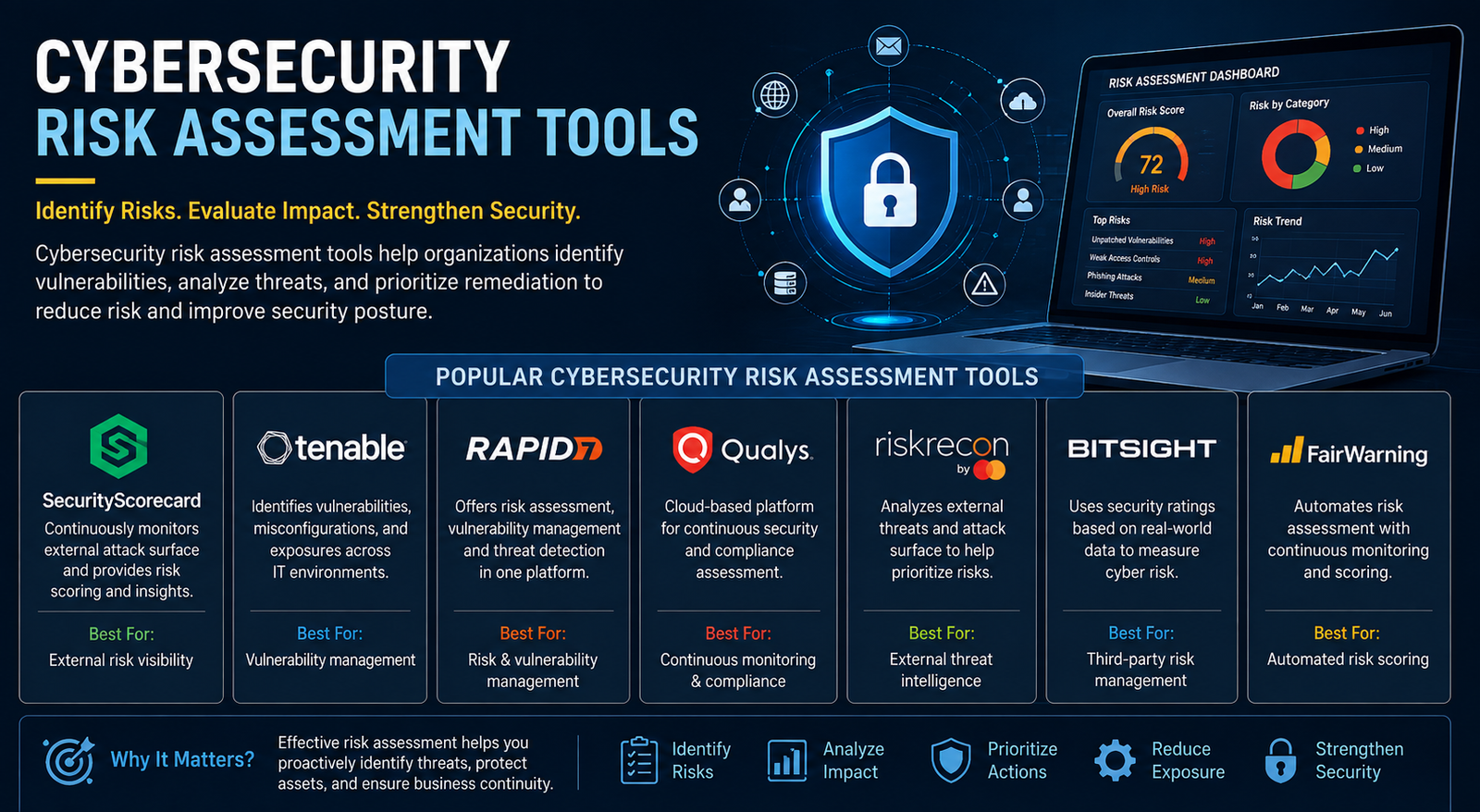
Cybersecurity risks can come from vulnerable software, misconfigured systems, employees, third-party vendors, cloud environments, and weak security controls. Finding these risks manually is difficult, especially as an organization grows.
That is where cybersecurity risk assessment tools can help. They can identify vulnerabilities, evaluate security controls, organize risk findings, support compliance, assess vendors, and help security teams prioritize remediation.
However, not every tool does the same job. A vulnerability scanner is different from GRC software, while a third-party risk platform serves a different purpose from a cyber risk quantification solution.
This guide explains the major tool categories, compares leading options, highlights free resources, and shows how to choose the right solution for your organization.
What Are Cybersecurity Risk Assessment Tools?
Cybersecurity risk assessment tools are software platforms or resources that help organizations identify, analyze, prioritize, document, and monitor security risks.
Depending on the platform, capabilities may include vulnerability discovery, asset inventory, risk scoring, compliance assessments, vendor questionnaires, control monitoring, reporting, and remediation tracking.
A complete assessment typically connects several activities:
Assets → Threats → Vulnerabilities → Likelihood and Impact → Risk → Remediation → Monitoring
NIST's Cybersecurity Framework 2.0 is useful for understanding this broader approach because it provides cybersecurity outcomes organizations can use to assess, prioritize, and communicate cybersecurity risk. Importantly, NIST CSF 2.0 is a framework, not a commercial software product.
What Does a Cybersecurity Risk Assessment Tool Do?
The exact capabilities vary, but strong platforms generally support several core functions.
Asset and Vulnerability Identification
A tool can help security teams discover systems, applications, endpoints, cloud resources, and vulnerabilities. Vulnerability assessment is valuable, but a critical vulnerability does not automatically mean it represents the highest business risk.
Risk Scoring and Prioritization
Risk assessment software can combine factors such as vulnerability severity, likelihood, asset importance, exposure, and business impact to help teams decide what needs attention first.
NIST SP 800-30 Rev. 1 describes risk assessment as part of an overall risk-management process and considers threats, vulnerabilities, likelihood, and potential impact.
Compliance and Control Assessments
Many GRC platforms map security controls to frameworks and regulations such as NIST CSF, ISO 27001, PCI DSS, HIPAA, CIS Controls, or SOC 2.
Third-Party Risk
Organizations increasingly need to evaluate suppliers, software providers, contractors, and other external partners. Vendor questionnaires, external security ratings, and continuous monitoring can help identify supply-chain risks.
Reporting and Risk Registers
Good tools turn technical findings into actionable information. Security teams can track risk owners, remediation deadlines, evidence, control gaps, and changes in overall risk.
Types of Cybersecurity Risk Assessment Tools
Before choosing a product, identify what type of assessment you actually need.
This distinction matters because buying an advanced GRC platform will not necessarily replace a dedicated vulnerability scanner, and a vulnerability scanner will not automatically provide complete vendor-risk management.
15 Best Cybersecurity Risk Assessment Tools for 2026
The best option depends on your environment, budget, risk priorities, integrations, and compliance requirements. Rather than treating one vendor as universally superior, consider these established platforms and tool categories as potential options to evaluate.
CyberSaint
CyberSaint is focused on enterprise cyber risk management, including risk quantification, compliance, risk registers, and executive-level reporting.
Best for: Enterprise security and GRC teams.
LogicGate
LogicGate provides a flexible risk and compliance platform designed around configurable workflows.
Best for: Organizations that need customizable GRC processes.
ServiceNow GRC
ServiceNow's GRC capabilities can connect risk and compliance workflows with broader IT and business processes.
Best for: Large organizations already using the ServiceNow ecosystem.
RSA Archer
RSA Archer is an established GRC platform covering areas such as enterprise risk, compliance, and cybersecurity risk management.
Best for: Large enterprises with complex governance requirements.
MetricStream GRC
MetricStream is another enterprise-focused GRC platform covering risk, compliance, audit, and related governance activities.
Best for: Organizations managing broad enterprise GRC programs.
Balbix
Balbix focuses heavily on cyber asset visibility, security posture, and risk prioritization.
Best for: Organizations that need broad visibility into cyber risk and assets.
Safe Security
Safe Security focuses on measuring and quantifying cyber risk and helping organizations communicate that risk to business stakeholders.
Best for: Security leaders interested in cyber risk quantification.
Vanta
Vanta is widely associated with security compliance automation and helping organizations manage frameworks and evidence.
Best for: Companies that need streamlined compliance and security program management.
Drata
Drata provides compliance automation and security compliance management capabilities.
Best for: Growing organizations building or maintaining compliance programs.
ConnectWise
ConnectWise offers security solutions aimed strongly at managed service providers and IT service organizations.
Best for: MSPs managing security across multiple clients.
Vulnerability Scanners
Dedicated vulnerability assessment platforms can identify weaknesses in systems, applications, and infrastructure.
Best for: Technical teams that primarily need vulnerability discovery and remediation prioritization.
Security-Rating Platforms
These services evaluate an organization's externally observable security posture and can also help assess third parties.
Best for: Security leaders and procurement teams evaluating external exposure.
Third-Party Risk Platforms
Vendor risk tools automate questionnaires, assessments, evidence collection, risk scoring, and supplier monitoring.
Best for: Organizations with large or security-sensitive vendor ecosystems.
Breach and Attack Simulation Tools
BAS platforms simulate attack techniques to test whether security controls are working as expected.
Best for: Mature security teams validating defensive controls.
NIST Cybersecurity Framework Resources
NIST CSF 2.0 is not commercial risk assessment software, but it is an important free resource for structuring cybersecurity risk management. NIST provides the framework, profiles, mappings, quick-start guides, and other supporting resources.
Best for: Organizations that need a recognized framework before selecting or configuring software.
Cybersecurity Risk Assessment Tools Compared
Use this table as a starting point rather than treating every platform as a direct substitute.
Features and pricing can change, so verify current capabilities with the vendor before purchasing.
Best Cybersecurity Risk Assessment Tools by Use Case
There is no single best cybersecurity risk assessment tool for every organization.
Best for Small Businesses
Small businesses should prioritize affordability, ease of deployment, straightforward reporting, and essential security visibility. A combination of free NIST resources, vulnerability assessment, and lightweight compliance software can often be more practical than a complex enterprise GRC platform.
Best for Enterprises
Large organizations may benefit from enterprise GRC platforms such as ServiceNow, RSA Archer, MetricStream, LogicGate, or dedicated cyber risk quantification platforms.
Best for MSPs
MSPs should look for multi-client management, automation, scalable reporting, and centralized security visibility. This is where MSP-oriented platforms can have an advantage.
Best for Healthcare
Healthcare organizations should consider tools that support regulatory requirements, security controls, vendor risk, evidence collection, and protection of sensitive information.
Best for Third-Party Risk
Organizations with hundreds of vendors should prioritize automated questionnaires, external security intelligence, risk scoring, evidence management, and continuous vendor monitoring.
Free Cybersecurity Risk Assessment Tools
Not every organization needs to purchase expensive software.
Free resources can provide a strong foundation, particularly for smaller teams. NIST's CSF 2.0 resources are available publicly and can help organizations structure cybersecurity risk management.
Other options include:
Free vulnerability scanners or limited free tiers
Open-source security tools
Security configuration checklists
Spreadsheet-based risk registers
Vendor security questionnaires
Framework assessment templates
A free approach requires more manual work, but it can be an effective starting point.
If you are researching a cybersecurity risk assessment tools blog or browsing Reddit discussions for recommendations, remember that community experiences can be useful for discovering practical pros and cons, but official documentation should be used to verify features, pricing, and security claims.
NIST vs Cybersecurity Risk Assessment Software
NIST and commercial risk assessment platforms serve different purposes.
NIST CSF 2.0 is a framework that provides high-level cybersecurity outcomes and a common language for managing risk. It does not prescribe one specific technology or implementation.
NIST SP 800-30 Rev. 1 provides risk assessment guidance, including concepts around threats, vulnerabilities, likelihood, impact, and risk.
Risk assessment software automates or organizes parts of that work.
For example, a company might use NIST CSF to structure its cybersecurity program, a vulnerability scanner to discover technical weaknesses, and GRC software to document controls and track remediation.
That combination is often more useful than expecting one product to perform every cybersecurity function.
How to Perform a Cybersecurity Risk Assessment
A practical assessment can follow these steps:
1. Define the Scope
Identify the systems, business processes, locations, cloud environments, and third parties being assessed.
2. Inventory Assets
Determine what hardware, software, data, applications, and services need protection.
3. Identify Threats
Consider ransomware, phishing, credential theft, insider threats, supply-chain attacks, and other relevant scenarios.
4. Identify Vulnerabilities
Use technical assessment tools, configuration reviews, penetration testing, and other appropriate methods.
5. Evaluate Existing Controls
Determine whether controls such as MFA, endpoint protection, backups, network segmentation, and access management are effective.
6. Estimate Likelihood and Impact
Consider how likely an event is and what damage it could cause.
7. Prioritize Risk
A simple model is:
Risk = Likelihood × Impact
Organizations can use more sophisticated qualitative or quantitative approaches when necessary.
8. Assign Ownership
Every significant risk should have someone responsible for addressing it.
9. Remediate
Prioritize fixes according to business risk rather than simply fixing findings in numerical severity order.
10. Monitor and Reassess
Risk changes as systems, vendors, threats, and business operations change. NIST describes risk assessment as part of an ongoing risk-management process rather than a one-time exercise.
Common Mistakes When Choosing a Risk Assessment Tool
One common mistake is choosing the platform with the longest feature list. Complexity can become a disadvantage if your team cannot use the features effectively.
Another mistake is treating vulnerability severity as business risk. A medium-severity weakness on a critical internet-facing system may deserve more attention than a high-severity issue on an isolated test machine.
Organizations should also avoid ignoring third-party risk, integration requirements, reporting needs, and the total cost of ownership.
If internal resources are limited, managed GRC services may be worth considering alongside software. GRC companies and security providers can sometimes provide expertise that a software license alone cannot.
What Should You Look for in a Cybersecurity Risk Assessment Tool?
Before buying, check whether the platform provides:
Asset visibility
Vulnerability assessment
Risk scoring
Business-impact analysis
Compliance mapping
Third-party risk management
Automation
Integrations
Reporting
Risk registers
Remediation tracking
Scalability
Transparent pricing
Also determine whether you need dedicated GRC software, vulnerability management, vendor risk management, or a combination of technologies.
Conclusion
The right cybersecurity risk assessment tools should do more than produce a list of vulnerabilities. They should help your organization understand which risks matter most, why they matter, who owns them, and what should happen next.
For smaller organizations, free NIST resources and focused security tools can provide a practical starting point. Larger enterprises may need GRC software, third-party risk management, cyber risk quantification, and continuous monitoring.
Most importantly, choose based on your actual risk-management goals rather than a vendor's feature count. A well-configured, appropriately sized solution is more valuable than an expensive platform your team cannot effectively operate.
Frequently Asked Questions
What are cybersecurity risk assessment tools?
Cybersecurity risk assessment tools help organizations identify, evaluate, prioritize, document, and monitor cybersecurity risks. Depending on the product, they may support vulnerability management, compliance, vendor assessments, risk scoring, and reporting.
What is the best cybersecurity risk assessment tool?
The best tool depends on your organization. Enterprises may need advanced GRC or cyber risk quantification, while smaller organizations may benefit from simpler assessment software combined with free NIST resources.
Is NIST a cybersecurity risk assessment tool?
No. NIST CSF 2.0 is a cybersecurity risk management framework, while SP 800-30 provides risk assessment guidance. Software can help organizations implement and manage processes based on such guidance.
What is the difference between a risk assessment tool and a vulnerability scanner?
A vulnerability scanner primarily identifies technical weaknesses. A broader risk assessment platform can consider vulnerabilities alongside business impact, controls, compliance, vendors, and other risk factors.
Are there free cybersecurity risk assessment tools?
Yes. Organizations can use free NIST resources, open-source tools, free vulnerability scanners or limited free tiers, checklists, questionnaires, and risk-register templates. Free options generally require more manual effort.
How often should a cybersecurity risk assessment be performed?
Organizations should establish a recurring assessment schedule and reassess when major changes occur, such as new technology deployments, acquisitions, significant vulnerabilities, new vendors, cloud migrations, or security incidents.
Is MetricStream GRC suitable for cybersecurity risk management?
MetricStream is an enterprise GRC platform that can be considered by organizations looking to manage cybersecurity risk alongside broader governance, risk, compliance, audit, and control processes. Evaluate its current capabilities against your specific requirements before purchasing.
Leave a Reply