

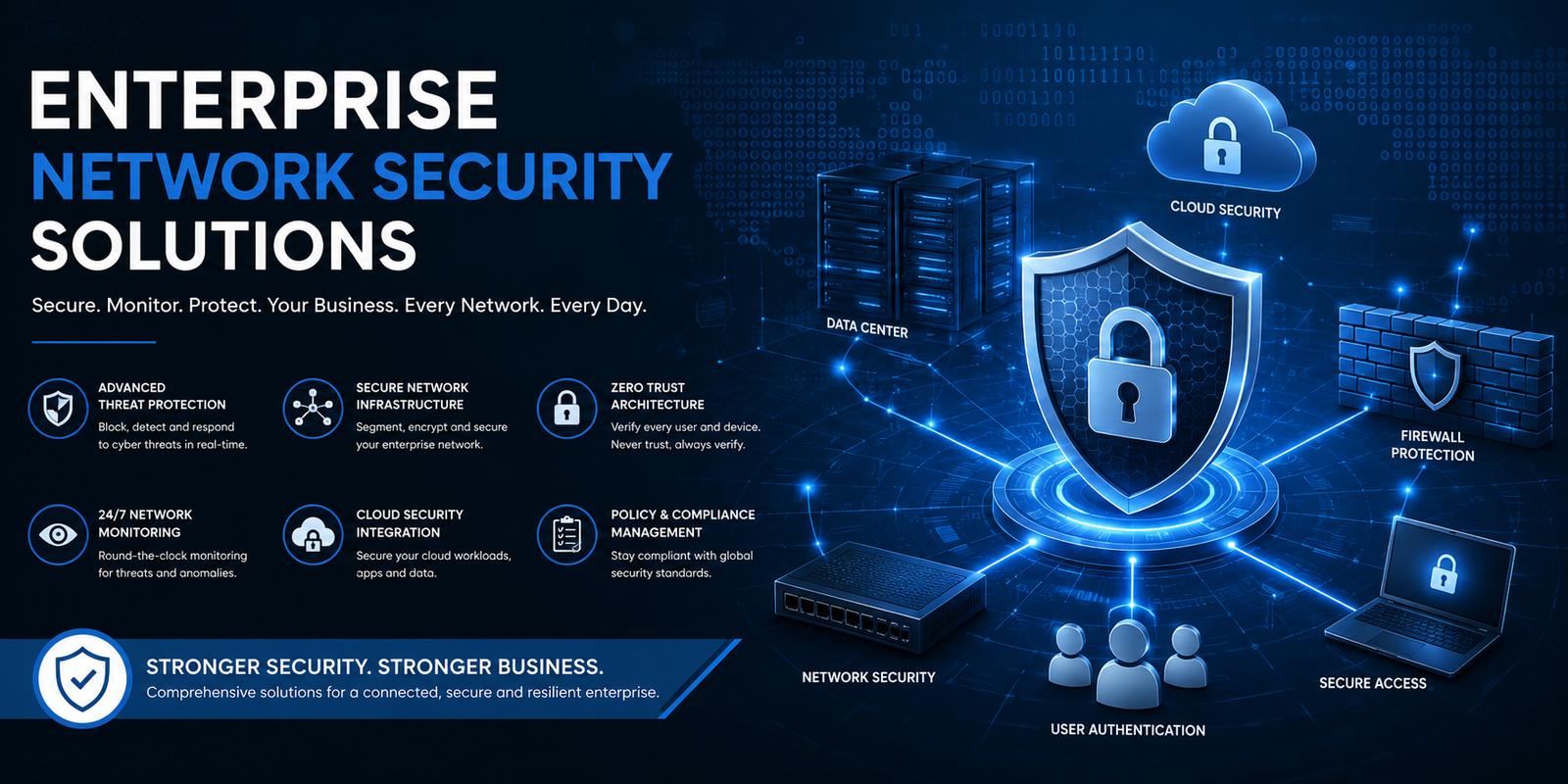
Enterprise networks have become increasingly complex as organisations embrace cloud computing, hybrid work, connected devices, and digital transformation. While these innovations improve productivity, they also create new opportunities for cybercriminals to exploit vulnerabilities. Ransomware, phishing, insider threats, and AI-powered attacks now target businesses of every size, making robust network protection a business necessity rather than an IT option.
Enterprise network security solutions provide a comprehensive framework for protecting users, devices, applications, and data across on-premises, cloud, and remote environments. Instead of relying on a single security tool, modern enterprises use layered defences that combine advanced firewalls, identity management, threat detection, automation, and continuous monitoring. This guide explains how enterprise network security works, its essential components, implementation best practices, and how to choose the right solution for your organisation.
What Are Enterprise Network Security Solutions?
Enterprise network security solutions are integrated technologies, policies, and processes designed to protect an organisation's entire network infrastructure from cyber threats. These solutions secure internal networks, branch offices, cloud environments, remote employees, and connected devices while maintaining business continuity.
Unlike traditional network security, which primarily focused on perimeter defence, enterprise security adopts a multi-layered approach. Every user, device, and application is continuously verified before access is granted. This strategy significantly reduces the risk of data breaches and unauthorised access.
For example, a global company with offices across multiple countries can secure employees working from headquarters, home offices, and public locations through a unified security platform that continuously monitors traffic and detects suspicious behaviour.
Why Enterprise Network Security Is Critical in 2026
Cyber threats continue to evolve at an unprecedented pace. Attackers increasingly use artificial intelligence, automation, and sophisticated social engineering techniques to bypass conventional security controls.
Modern organisations also face growing challenges due to remote work, cloud adoption, Internet of Things (IoT) devices, and third-party integrations. Every connected asset expands the attack surface and creates additional security risks.
Regulatory requirements such as GDPR, HIPAA, PCI DSS, and ISO 27001 further increase the importance of maintaining secure enterprise networks. A strong security strategy helps organisations protect sensitive information, reduce downtime, maintain customer trust, and avoid costly compliance violations.
Common Security Challenges Enterprises Face
Expanding Attack Surface
Every cloud application, remote device, mobile employee, and connected sensor introduces new entry points for attackers. Without proper visibility, security teams struggle to identify potential vulnerabilities.
Remote Workforce Security
Hybrid work environments require secure access from virtually anywhere. Traditional VPN solutions often lack the flexibility and visibility required for modern enterprise environments.
Multi-Cloud Complexity
Many organisations now operate across multiple cloud providers while maintaining on-premises infrastructure. Managing consistent security policies across these environments can become extremely challenging.
Insider Threats
Not every cyber threat originates outside the organisation. Employees, contractors, or compromised accounts may intentionally or accidentally expose sensitive business data.
Legacy Systems
Older infrastructure often lacks modern security capabilities and may no longer receive vendor updates, making it an attractive target for attackers.
Compliance Requirements
Industries such as healthcare, finance, and government must continuously demonstrate compliance with strict security regulations, requiring comprehensive monitoring and reporting capabilities.
Core Components of Enterprise Network Security Solutions
An effective enterprise security strategy combines multiple technologies that work together to provide layered protection.
Next-Generation Firewalls (NGFW)
Modern firewalls inspect network traffic beyond traditional port filtering. They analyse applications, users, encrypted traffic, and advanced threats in real time.
Intrusion Detection and Prevention Systems
IDS and IPS continuously monitor network activity to detect malicious behaviour and automatically block suspicious traffic before damage occurs.
Identity and Access Management
Identity management ensures only authorised users can access corporate resources. Combined with Multi-Factor Authentication (MFA), it significantly reduces account compromise risks.
Zero Trust Network Access (ZTNA)
Zero Trust eliminates implicit trust by verifying every access request regardless of user location or device. This model has become essential for hybrid workforces.
Secure Access Service Edge (SASE)
SASE combines networking and security services into a cloud-delivered platform, enabling secure remote access while simplifying enterprise infrastructure.
Endpoint Detection and Response (EDR)
EDR continuously monitors laptops, desktops, and servers for suspicious behaviour, allowing rapid detection and response to malware infections.
Extended Detection and Response (XDR)
XDR integrates endpoint, cloud, email, identity, and network telemetry into a single platform, improving threat visibility across the organisation.
Security Information and Event Management (SIEM)
SIEM platforms collect logs from multiple security tools, correlate events, and provide centralised monitoring for security operations teams.
Data Loss Prevention (DLP)
DLP solutions prevent sensitive information from being accidentally or intentionally shared outside the organisation.
Comparison of Essential Enterprise Security Technologies
Enterprise Network Security Architecture Explained
Modern enterprise security relies on multiple interconnected layers instead of a single perimeter defence.
The first layer focuses on user identity, ensuring only verified users receive access to business resources. The second layer secures endpoints such as laptops, servers, smartphones, and IoT devices. The third layer protects network traffic using advanced firewalls, segmentation, and intrusion prevention systems.
Cloud security forms another critical layer by protecting applications and workloads across public and private cloud environments. Finally, continuous monitoring and security analytics provide real-time visibility into potential threats, enabling rapid incident response.
This layered architecture ensures that even if one defence fails, additional controls continue protecting critical assets.
Traditional Security vs Zero Trust
Many organisations are replacing perimeter-based security with Zero Trust architecture.
Zero Trust significantly reduces lateral movement by attackers and improves visibility across hybrid environments.
Enterprise Network Security Best Practices
Building a resilient security programme requires more than purchasing software. Organisations should adopt proven operational practices that strengthen their overall security posture.
Apply the principle of least privilege by granting users only the permissions necessary for their roles. Enable Multi-Factor Authentication across all critical systems to reduce credential-based attacks.
Segment networks to isolate sensitive systems from general business traffic. Encrypt data both in transit and at rest to protect confidential information from interception.
Perform regular vulnerability assessments and penetration testing to identify weaknesses before attackers do. Ensure software patches are applied promptly and maintain an up-to-date inventory of all connected assets.
Employee awareness training remains equally important. Educating staff about phishing attacks, password hygiene, and social engineering significantly reduces human error.
How to Choose the Right Enterprise Network Security Solution
Selecting the right solution depends on your organisation's size, infrastructure, industry, and compliance requirements.
Look for platforms that provide comprehensive visibility across cloud, on-premises, and remote environments. Scalability is equally important, allowing security infrastructure to grow alongside the business.
Automation capabilities reduce response times while AI-powered analytics improve threat detection accuracy. Seamless integration with existing security tools also simplifies operations and reduces management overhead.
When evaluating vendors, consider product support, update frequency, ease of deployment, and independent Enterprise network security solutions reviews from trusted analysts and customers.
Industry Use Cases
Healthcare
Hospitals protect electronic health records, connected medical devices, and patient communications while complying with strict privacy regulations.
Financial Services
Banks secure online transactions, payment systems, customer accounts, and fraud detection platforms using layered security controls.
Manufacturing
Manufacturers protect industrial control systems, production networks, and connected operational technology from ransomware attacks.
Retail
Retail businesses safeguard payment systems, customer databases, and e-commerce platforms against increasingly sophisticated cyber threats.
Government
Public sector organisations secure critical infrastructure, confidential information, and citizen services while defending against advanced persistent threats.
Emerging Trends in Enterprise Network Security
Artificial intelligence continues transforming cybersecurity by enabling faster threat detection and automated incident response.
Intent-based security is gaining popularity by automatically adjusting security policies based on business intent and network behaviour. This approach improves efficiency while reducing manual administration.
Cloud-native security platforms continue replacing hardware-centric deployments, while passwordless authentication strengthens identity protection.
Many organisations are expanding Cisco enterprise networking deployments alongside advanced cloud security services to simplify secure connectivity across distributed locations.
Growing investment in Network security services also allows businesses to outsource monitoring and incident response to specialised security providers operating around the clock.
Enterprise Network Equipment and Vendor Considerations
Choosing the right Enterprise network equipment is just as important as selecting software. High-performance switches, routers, wireless infrastructure, and security appliances form the foundation of secure enterprise connectivity.
Many organisations evaluate Fortinet Enterprise firewall models due to their integrated security capabilities, application awareness, and centralised management. Proper implementation requires ongoing administrator education, making Fortinet network security certification valuable for security professionals seeking hands-on expertise.
Likewise, Fortinet enterprise Firewall training helps IT teams deploy, configure, and manage enterprise firewalls more effectively while maintaining compliance and reducing operational risks.
Measuring Security Success
A successful enterprise security programme should be continuously measured and improved.
Useful performance indicators include Mean Time to Detect (MTTD), Mean Time to Respond (MTTR), patch compliance rates, phishing simulation results, vulnerability remediation times, and incident frequency.
Regular reporting enables organisations to identify trends, justify security investments, and demonstrate compliance with regulatory requirements.
Conclusion
Enterprise network security solutions have become essential for protecting modern organisations against increasingly sophisticated cyber threats. As businesses expand across cloud platforms, remote work environments, and connected devices, traditional perimeter security is no longer sufficient.
A comprehensive security strategy combines advanced technologies such as Zero Trust, NGFW, SIEM, XDR, identity management, and continuous monitoring to create multiple layers of defence. By adopting best practices, investing in skilled personnel, and selecting scalable security solutions, organisations can reduce cyber risks, improve compliance, and strengthen business resilience for the future.
Frequently Asked Questions
What are enterprise network security solutions?
Enterprise network security solutions are integrated technologies and processes that protect business networks, users, applications, devices, and data from cyber threats across on-premises and cloud environments.
How is enterprise network security different from traditional network security?
Traditional security mainly protects the network perimeter, while enterprise network security uses layered protection, Zero Trust principles, continuous monitoring, and identity-based access controls.
Why is Zero Trust important?
Zero Trust verifies every user and device before granting access, reducing the risk of unauthorised access, insider threats, and lateral movement during cyberattacks.
Which industries benefit most from enterprise network security?
Healthcare, finance, manufacturing, retail, education, government, and technology companies all rely on enterprise network security to protect sensitive information and maintain regulatory compliance.
What technologies are essential for enterprise network security?
Key technologies include Next-Generation Firewalls, SIEM, XDR, IAM, MFA, ZTNA, SASE, EDR, IDS/IPS, DLP, and network segmentation.
How often should organisations perform security assessments?
Most organisations should conduct vulnerability assessments quarterly, penetration testing annually, and continuous monitoring throughout the year to maintain strong security.
Leave a Reply