

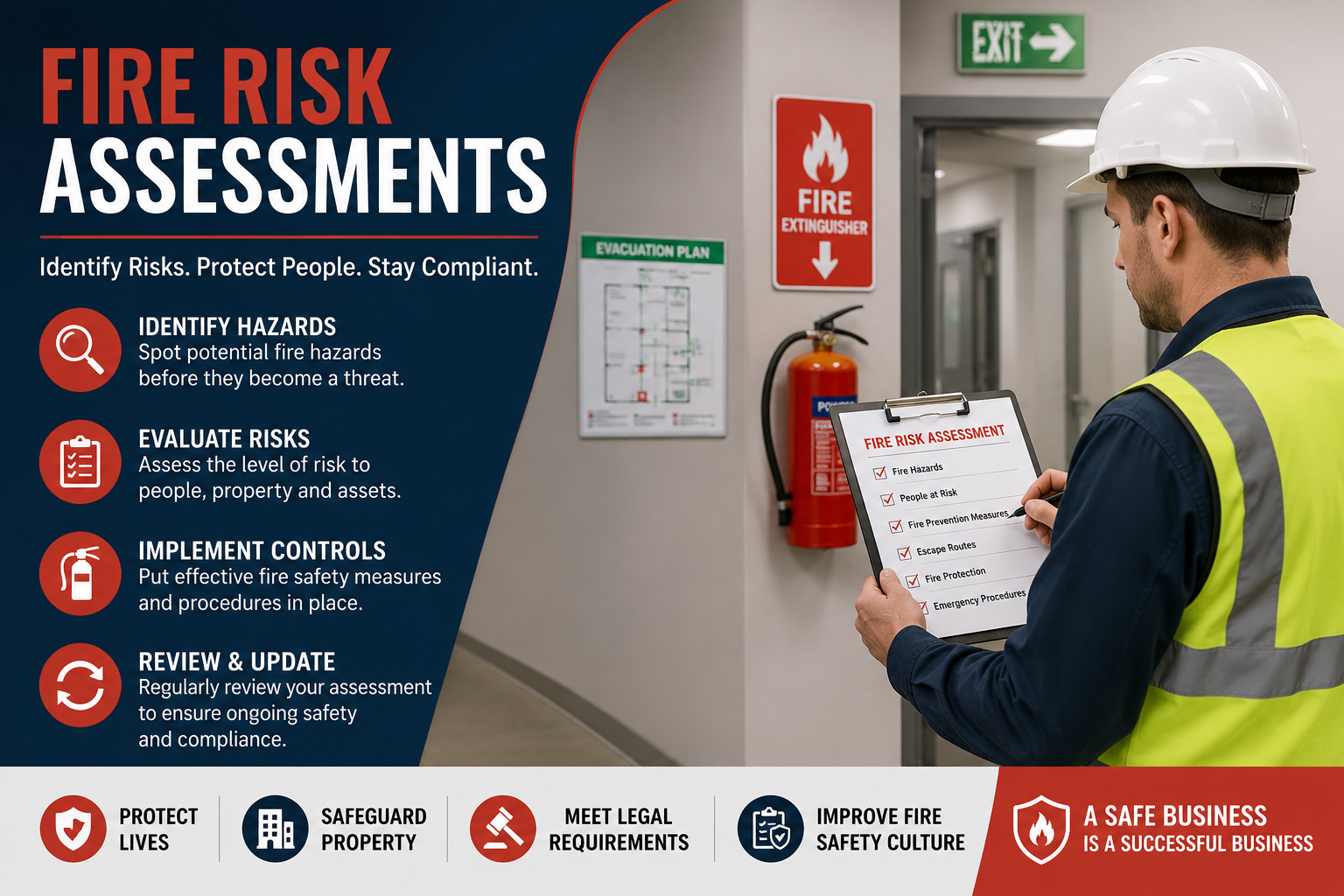
Fire risk assessments help organizations identify what could cause a fire, who could be harmed, how existing controls perform, and what needs to be improved. They are an essential part of effective fire safety management in workplaces and other occupied buildings.
A good assessment is more than a form or checklist. It should lead to practical action, from correcting electrical hazards and protecting escape routes to improving emergency procedures and staff training. This guide explains the fire risk assessment process, what to include, how to document findings, and when an assessment should be reviewed.
Important: Fire safety laws and assessment requirements vary by country, building type, and occupancy. Use this guide as general educational information and check the requirements that apply to your premises.
What Is a Fire Risk Assessment?
A fire risk assessment is a structured process used to identify fire hazards, determine who may be at risk, evaluate existing precautions, and decide what additional measures are needed.
Typical hazards include electrical equipment, heating systems, cooking appliances, combustible materials, smoking, poor housekeeping, and activities involving flammable or dangerous substances. A proper assessment also considers escape routes, fire detection, firefighting equipment, emergency procedures, and the needs of vulnerable occupants.
A useful way to think about the process is:
Identify → Evaluate → Control → Record → Review
The assessment should reflect the actual conditions of the building rather than simply reproducing information from a generic template.
Why Are Fire Risk Assessments Important?
The primary purpose is to protect people from fire. An assessment can reveal hazards before they become incidents and help organizations prioritize improvements based on the level of risk.
Fire safety also affects business continuity. A serious fire can damage buildings, equipment, inventory, records, and critical infrastructure while forcing an organization to stop operating.
For UK premises, official guidance describes fire risk assessment as a five-step process covering hazards, people at risk, evaluation and reduction of risk, recording/planning/training, and review.
Who Is Responsible for a Fire Risk Assessment?
Responsibility depends on the jurisdiction and type of premises. In the UK, the person with legal responsibility is generally referred to as the Responsible Person under applicable fire safety legislation.
The assessment does not automatically have to be completed by an external consultant. What matters is that the person conducting it has the appropriate competence for the complexity and risk of the premises.
When Should You Hire a Professional?
Professional assistance is particularly valuable for:
Large or complex buildings
High-risk industrial processes
Premises storing hazardous substances
Buildings with vulnerable occupants
Complex evacuation arrangements
Significant structural changes
Specialized fire engineering requirements
Situations where internal expertise is limited
A competent assessor should understand both fire hazards and the specific characteristics of the premises being assessed.
What Does a Fire Risk Assessment Include?
A comprehensive assessment normally considers five major areas.
1. Building and Occupancy
Document the building's use, layout, floors, occupancy, operating hours, access arrangements, and relevant construction features.
2. Fire Hazards
Look for sources of ignition, combustible materials, and conditions that could allow fire to develop or spread.
Examples include:
Faulty electrical equipment
Portable heaters
Cooking appliances
Smoking materials
Machinery
Paper and packaging
Flammable liquids
Accumulated waste
3. People at Risk
Consider employees, visitors, customers, contractors, temporary workers, lone workers, and people who may require additional assistance during evacuation.
Official guidance specifically recommends considering groups such as young, disabled, and lone workers during the assessment.
4. Fire Safety Controls
Review measures such as:
Fire alarms and detection
Emergency lighting
Fire doors
Escape routes
Fire extinguishers
Sprinkler systems where applicable
Fire safety signage
Emergency procedures
Staff training
5. Documentation and Action
The assessment should clearly identify deficiencies and specify what needs to be done, who is responsible, and when corrective action should be completed.
How to Conduct a Fire Risk Assessment: 5 Steps
Step 1: Identify Fire Hazards
Inspect the premises for anything that could start or contribute to a fire.
Check electrical systems, heating equipment, cooking areas, storage rooms, waste, machinery, charging equipment, and hazardous substances.
For example, cardboard stored next to a heat-producing appliance creates a preventable combination of fuel and ignition. Moving the storage and controlling the heat source can reduce the hazard before an incident occurs.
Step 2: Identify People at Risk
Determine who could be affected if a fire starts.
Ask:
How many people normally occupy the building?
Are visitors regularly present?
Are there lone workers?
Are contractors working on-site?
Could anyone have difficulty hearing an alarm?
Does anyone require assistance to evacuate?
Are there areas where people could become trapped?
The answers should influence evacuation arrangements and other controls.
Step 3: Evaluate and Reduce the Risk
Evaluate the likelihood of a fire and the potential consequences to people and property.
A simple organizational model can use:
Risk = Likelihood × Consequence
For example, an obstructed emergency exit may have a high consequence because it could delay evacuation. Even if the likelihood of a fire is relatively low, the obstruction should still be corrected promptly.
Risk-scoring methods vary, so organizations should use a methodology appropriate to their premises and applicable requirements.
Step 4: Record Findings, Plan and Train
Document the significant findings and create an action plan.
Recording a problem is only the first step. Someone should be responsible for resolving it.
UK government guidance similarly emphasizes recording findings, developing an action plan, preparing an emergency plan, and providing training.
Step 5: Review and Update the Assessment
A fire risk assessment should not be completed and forgotten.
Review it when circumstances change, such as:
Building alterations
Changes to internal layout
New equipment
New work processes
Increased occupancy
Changes in hazardous-substance storage
Failure of fire protection systems
A fire or near miss
Significant changes affecting occupants
UK government guidance states that assessments should be reviewed regularly and when significant changes affect fire precautions; it also notes that an annual review is recognized as good practice for small, simple premises.
Fire Risk Assessment Checklist
Use this as a starting point when reviewing a workplace.
Building and Premises
Escape routes are clear
Emergency exits are accessible
Fire doors function correctly
Exit signage is visible
Emergency lighting is maintained
Fire Hazards
Electrical equipment is appropriately maintained
Heating equipment is safe
Combustible waste is controlled
Flammable materials are stored appropriately
Ignition sources are controlled
Housekeeping standards are adequate
Fire Protection
Fire alarms are tested and maintained
Detection systems are appropriate
Fire extinguishers are suitable and maintained
Sprinkler systems are maintained where installed
Fire doors and compartmentation are checked
People and Evacuation
Staff know what to do during a fire
Visitors and contractors are considered
Vulnerable occupants are considered
Emergency procedures are documented
Fire drills are conducted where appropriate
Training records are maintained
This type of checklist can support an assessment, but it should not replace a competent evaluation of the actual premises.
Fire Risk Assessment Example
Consider a fictional two-floor office with 35 employees, a kitchen, electrical workstations, storage areas, and regular visitors.
During the assessment, the assessor discovers that a power strip is overloaded, cardboard boxes are stored close to a heating appliance, and an emergency exit is partially obstructed.
The findings could be documented as follows:
The important point is that the assessment connects each hazard with a specific corrective action.
This is a fictional example for educational purposes, not a substitute for an assessment of your premises.
What Should a Fire Risk Assessment Report Contain?
A useful report should make its findings understandable to the people responsible for fire safety.
It may include:
Property and organization details
Assessment date
Assessor details
Scope of the assessment
Building description
Occupancy information
Fire hazards
People at risk
Existing precautions
Risk evaluation
Deficiencies
Recommended actions
Priority levels
Responsible persons
Review date
Supporting records or photographs
Official UK guidance also provides example formats for recording significant findings, including sources of ignition, fuel, oxygen, people at risk, risk-reduction measures, and review information.
How Often Should Fire Risk Assessments Be Reviewed?
There is no universal review interval that applies to every building.
The correct approach is to keep the assessment current and review it when there is reason to believe it is no longer valid or when significant changes affect fire risk.
For example, a company that changes its building layout, introduces new machinery, increases storage of hazardous substances, or experiences a fire or near miss should consider whether the existing assessment remains adequate.
For UK readers, government guidance specifically says that the Fire Safety Order does not prescribe one fixed review frequency; review requirements depend on the circumstances, complexity, and risk of the premises.
Fire Risk Assessments by Building Type
The hazards vary considerably depending on how a building is used.
Offices: electrical equipment, kitchens, storage, escape routes, and visitor management are common considerations.
Warehouses: combustible stock, high storage levels, charging equipment, machinery, and access for emergency response may require greater attention.
Restaurants: cooking equipment, grease, extraction systems, gas or electrical appliances, and kitchen housekeeping can be important risk factors.
Schools: children, staff, visitors, evacuation arrangements, accessibility, and specialist rooms need consideration.
Healthcare facilities: vulnerable occupants, medical equipment, oxygen, compartmentation, and evacuation challenges can create additional complexity.
The assessment should therefore be tailored to the actual building rather than copied from another organization's template.
Common Fire Risk Assessment Mistakes
One of the most common mistakes is treating the assessment as paperwork rather than a risk-management process.
Other problems include:
Using a generic template without inspecting the premises
Ignoring vulnerable occupants
Focusing only on extinguishers and alarms
Failing to document corrective actions
Leaving emergency exits obstructed
Ignoring contractors or temporary workers
Not updating the assessment after renovations
Failing to investigate fire incidents or near misses
Identifying hazards without assigning someone to resolve them
An assessment becomes valuable when its findings lead to measurable improvements.
Fire Risk Assessment vs. Fire Safety Inspection
These terms are related but are not necessarily interchangeable.
An organization may use both approaches as part of a broader fire safety management system.
What Happens After a Fire Risk Assessment?
The assessment should result in a prioritized action plan.
Start by addressing urgent hazards that could immediately threaten life safety. Then assign responsibility for remaining improvements, establish target dates, and keep evidence of completed work.
Staff should also be informed about relevant changes. Fire safety arrangements, training, drills, maintenance, and emergency procedures should support the findings of the assessment.
The goal is not simply to produce a document. The goal is to reduce the likelihood of fire, limit its consequences, and help people evacuate safely.
Conclusion
Effective fire risk assessments turn fire safety from a checklist exercise into an ongoing risk-management process. The strongest assessments identify real hazards, consider everyone who could be affected, evaluate existing controls, document deficiencies, and turn findings into clear corrective actions.
Whether you are reviewing an office, warehouse, restaurant, school, or another type of premises, the key principle remains the same: identify the hazards, protect people, document the risks, take action, and keep the assessment up to date.
Frequently Asked Questions
What is the main purpose of a fire risk assessment?
The main purpose is to identify fire hazards, determine who could be harmed, evaluate existing precautions, and identify actions needed to reduce risk.
Who can carry out a fire risk assessment?
A suitable competent person may conduct an assessment when they have the knowledge and experience appropriate to the premises. Complex or high-risk buildings may require a qualified professional.
How often should a fire risk assessment be reviewed?
Review frequency depends on the building and its risk. It should be reviewed regularly and whenever significant changes could affect fire safety. UK guidance does not prescribe one universal interval.
What should a fire risk assessment include?
It should consider fire hazards, people at risk, existing fire precautions, evacuation arrangements, risk-reduction measures, corrective actions, documentation, and review requirements.
Can I use a free fire risk assessment template?
A free template can help organize information, but a template alone does not make an assessment adequate. It should be adapted to the actual premises and used by someone with appropriate competence.
What happens if an assessment identifies a serious fire hazard?
The hazard should be addressed according to its urgency. Immediate life-safety issues should not simply be left for the next scheduled review. Corrective actions should be assigned, tracked, and verified.
Is a fire risk assessment the same as a fire inspection?
No. A risk assessment evaluates hazards, people at risk, existing controls, and overall risk. An inspection may focus more specifically on physical conditions, systems, or compliance.
Leave a Reply