

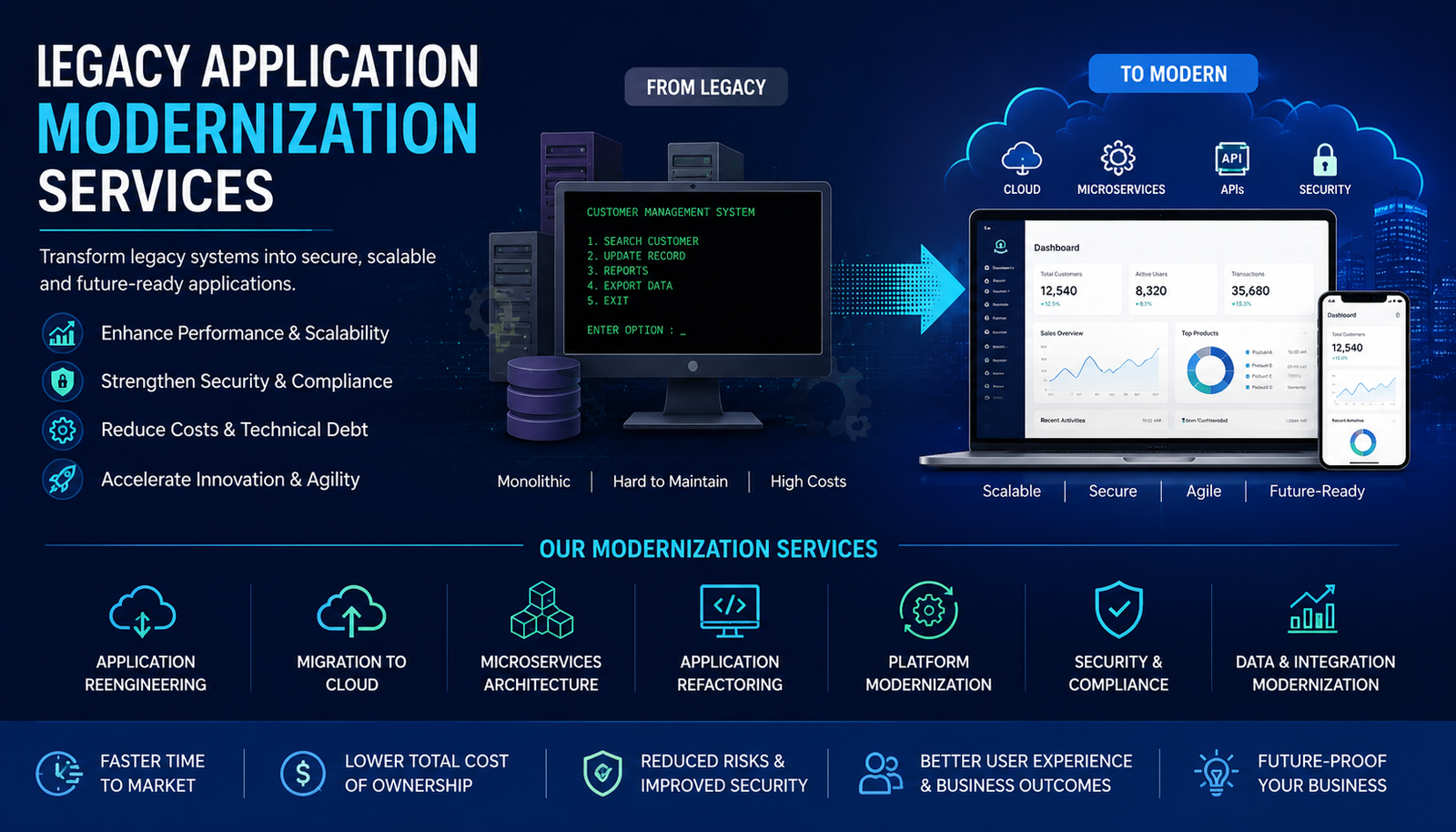
Legacy applications have supported businesses for years, but many now struggle to keep up with today's demands for speed, security, scalability, and cloud integration. As technology evolves, organisations face increasing maintenance costs, outdated infrastructure, and growing cybersecurity risks. Continuing to rely on ageing software can slow innovation and limit business growth.
Legacy application modernization services help organisations transform outdated systems into modern, secure, and high-performing applications without disrupting core business operations. Whether your goal is to migrate to the cloud, improve performance, or integrate with modern technologies, a well-planned modernization strategy ensures your applications remain valuable for years to come.
In this guide, you'll learn what legacy application modernization services involve, when to modernise, the most effective modernization strategies, the technologies used, common challenges, and best practices for achieving successful outcomes.
What Are Legacy Application Modernization Services?
Legacy application modernization services involve upgrading, transforming, or rebuilding older software applications so they meet current business and technology requirements. These services focus on improving performance, security, maintainability, and compatibility with modern platforms.
The legacy application meaning refers to software that has been in use for many years and still supports important business processes but relies on outdated technologies, programming languages, or infrastructure. Many legacy systems continue to operate successfully, yet they often require specialised maintenance and are difficult to integrate with newer applications.
Businesses often ask, what is a legacy application for college courses or IT programmes. In simple terms, it refers to an older software application that remains operational because it performs essential functions, even though newer technologies are available.
Rather than replacing an entire system, modernization allows organisations to preserve valuable business logic while improving functionality and reducing operational risks.
Signs Your Legacy Applications Need Modernization
Many organisations delay modernization until problems become costly. Recognising the warning signs early allows businesses to plan upgrades strategically rather than reacting to system failures.
Common indicators include:
Increasing maintenance and support costs
Frequent software outages
Slow application performance
Limited scalability
Difficulty integrating with cloud services
Security vulnerabilities
Unsupported operating systems or databases
Poor user experience
Long development cycles
Compliance challenges
If your IT team spends more time fixing issues than delivering innovation, modernization has likely become a business priority.
Benefits of Legacy Application Modernization Services
Modernization delivers benefits beyond technical improvements. It helps organisations become more agile, competitive, and prepared for future growth.
Key advantages include:
Reduced infrastructure and maintenance costs
Improved application performance
Stronger cybersecurity protection
Better scalability
Faster deployment of new features
Enhanced customer experience
Easier integration with third-party systems
Improved regulatory compliance
Greater business continuity
Increased developer productivity
Common Legacy Application Modernization Strategies
Every organisation has different business goals, so choosing the right modernization approach is essential.
Rehosting
Often called "lift and shift," rehosting moves applications to cloud infrastructure without significant code changes. It is suitable for businesses seeking faster cloud adoption with minimal disruption.
Replatforming
Replatforming introduces small modifications that improve application performance while maintaining the application's core architecture.
Refactoring
Refactoring restructures application code to improve efficiency, maintainability, and performance without changing its core functionality.
Rearchitecting
This strategy redesigns the application's architecture, often converting monolithic systems into microservices to improve scalability and flexibility.
Rebuilding
Rebuilding recreates the application using modern technologies while preserving important business requirements.
Replacing
When software no longer meets business needs, replacing it with a commercial or cloud-based solution may be the best option.
Retiring
Applications that no longer provide business value should be safely decommissioned to reduce operational complexity and costs.
Our Legacy Application Modernization Process
Successful modernization follows a structured methodology rather than isolated technology upgrades.
Application Assessment
The first step evaluates application health, business importance, technical debt, and future requirements.
Technology Review
Existing programming languages, databases, infrastructure, and integrations are assessed to identify modernization opportunities.
Business Impact Analysis
Critical business processes, dependencies, and operational risks are evaluated before any migration begins.
Modernization Roadmap
A phased implementation plan outlines priorities, timelines, milestones, and expected outcomes.
Development and Migration
Applications are modernised using appropriate modernization strategies while ensuring minimal downtime.
Testing and Quality Assurance
Comprehensive testing validates application functionality, security, performance, and compatibility.
Deployment and Monitoring
Applications are deployed gradually while performance, availability, and user feedback are continuously monitored.
Technologies Used in Legacy Application Modernization
Modernization relies on technologies that improve flexibility, scalability, and operational efficiency.
Popular technologies include:
Microservices
Docker
Kubernetes
REST APIs
GraphQL
DevOps
CI/CD pipelines
Serverless computing
Cloud-native architecture
Containerisation
Database modernisation
Event-driven architecture
One of the fastest-growing trends is legacy modernization with AI. Artificial intelligence can analyse legacy code, identify technical debt, generate documentation, recommend code improvements, automate testing, and accelerate migration planning. AI-assisted modernization helps reduce project timelines while improving code quality.
Cloud Modernization Options
Cloud adoption is one of the primary drivers behind modernization initiatives.
Businesses typically choose from:
Public Cloud
Offers scalability, flexibility, and reduced infrastructure management.
Private Cloud
Provides greater control and enhanced security for highly regulated industries.
Hybrid Cloud
Combines on-premises infrastructure with public cloud resources for greater flexibility.
Multi-Cloud
Uses services from multiple cloud providers to improve resilience and avoid vendor lock-in.
Selecting the right deployment model depends on compliance requirements, workload characteristics, and business objectives.
Legacy Systems We Modernize
Modernization services support a wide range of enterprise technologies, including:
Mainframe applications
COBOL systems
Java applications
.NET applications
Oracle Forms
SQL Server databases
ERP platforms
CRM systems
PHP applications
Visual Basic software
Desktop applications
Custom enterprise software
These applications often contain valuable business logic that organisations want to preserve while improving performance and security.
Legacy Modernization Examples
Real-world legacy modernization examples demonstrate how businesses improve efficiency without replacing every existing system.
For example, a manufacturing company may modernise a legacy inventory management application by migrating its database to the cloud while exposing core functionality through APIs. This allows mobile applications, supplier systems, and reporting tools to access data without disrupting existing operations.
Similarly, a financial institution might modernise a decades-old customer management platform by breaking its monolithic architecture into independent microservices. The result is faster software updates, better scalability, and stronger cybersecurity.
These examples highlight that modernization is not always about replacing software but making it more adaptable to current business needs.
Legacy System Modernization Case Study
Consider a retail organisation operating an ageing ERP system across multiple locations.
Challenges
Slow transaction processing
Frequent downtime
Expensive infrastructure
Difficult integrations
Limited reporting capabilities
Modernization Approach
The organisation implemented a phased modernization strategy by migrating infrastructure to the cloud, introducing APIs, modernising the database, and gradually converting selected components into microservices.
Results
Faster application response times
Reduced infrastructure costs
Improved scalability during seasonal demand
Better customer experience
Simplified future software updates
This legacy system modernization case study demonstrates how phased modernization reduces risk while delivering measurable business value.
Common Challenges During Modernization
Although modernization provides significant benefits, organisations should prepare for several challenges.
Common issues include:
Data migration complexity
Legacy code documentation gaps
Downtime concerns
Integration with existing systems
Compliance requirements
Skills shortages
Budget management
Change management
A comprehensive assessment and phased implementation strategy help minimise these risks.
Best Practices for Successful Legacy Software Modernization
Successful legacy software modernization requires careful planning and continuous collaboration between technical and business stakeholders.
Recommended best practices include:
Assess application dependencies early
Prioritise high-value applications
Modernise incrementally where possible
Automate testing
Build secure API integrations
Strengthen cybersecurity throughout the project
Continuously monitor application performance
Document architectural changes
Train internal teams
Measure business outcomes using clear KPIs
Organisations that follow these practices typically experience smoother implementations and stronger long-term returns.
Cost Factors of Legacy Application Modernization Services
Modernization costs vary depending on several factors.
Important considerations include:
Application complexity
Number of users
Programming language
Infrastructure size
Cloud migration requirements
Security improvements
Database migration
Third-party integrations
Compliance obligations
Project timeline
Rather than focusing solely on upfront costs, organisations should evaluate long-term savings through reduced maintenance, improved productivity, and greater operational efficiency.
How to Choose the Right Modernization Partner
Selecting an experienced modernization provider significantly influences project success.
Look for a partner that offers:
Enterprise modernization experience
Cloud platform expertise
Proven migration methodology
Strong cybersecurity capabilities
DevOps and automation expertise
Transparent communication
Industry-specific experience
Post-deployment support
Ongoing optimisation services
A reliable partner should begin every engagement with a comprehensive application assessment before recommending modernization strategies.
Measuring Success After Modernization
Modernization should produce measurable business improvements.
Useful performance indicators include:
Application response time
System availability
Deployment frequency
Infrastructure cost reduction
Security incident reduction
Customer satisfaction
Release cycle improvements
Cloud resource utilisation
Recovery time objectives
Employee productivity
Tracking these metrics helps organisations demonstrate return on investment and identify future optimisation opportunities.
Conclusion
Legacy applications remain essential to many organisations, but outdated technologies can hinder innovation, increase costs, and expose businesses to unnecessary risks. Legacy application modernization services provide a practical path to transforming ageing software into secure, scalable, and cloud-ready solutions while preserving valuable business functionality.
Whether your organisation chooses rehosting, refactoring, rearchitecting, or a complete rebuild, a well-planned modernization strategy delivers long-term value through improved performance, stronger security, greater agility, and lower operating costs. By partnering with experienced professionals and following proven best practices, businesses can modernise with confidence and build a stronger foundation for future growth.
Frequently Asked Questions
What are legacy application modernization services?
Legacy application modernization services help organisations upgrade outdated software using modern technologies, cloud platforms, APIs, and architectural improvements while preserving important business functionality.
What is the difference between legacy software modernization and application replacement?
Modernization improves an existing application without completely replacing it, whereas replacement involves implementing entirely new software that performs similar business functions.
How long does a legacy modernization project take?
Project duration depends on application complexity, technology stack, business requirements, and migration strategy. Smaller projects may take a few months, while enterprise programmes can extend over a year.
Can legacy systems be migrated to the cloud?
Yes. Many legacy systems can be rehosted, replatformed, or rearchitected for public, private, hybrid, or multi-cloud environments, depending on business needs.
How does AI support legacy modernization?
Legacy modernization with AI accelerates code analysis, identifies technical debt, automates documentation, recommends code improvements, assists testing, and helps development teams modernise applications more efficiently.
Is modernization suitable for every legacy application?
Not always. Some applications deliver greater value through replacement or retirement. A comprehensive assessment helps determine the most appropriate modernization strategy.
What is a legacy modernization icon?
A legacy modernization icon is a visual symbol commonly used in architecture diagrams, presentations, or documentation to represent the transformation of legacy systems into modern applications. It helps communicate modernization workflows and digital transformation initiatives.
Leave a Reply