

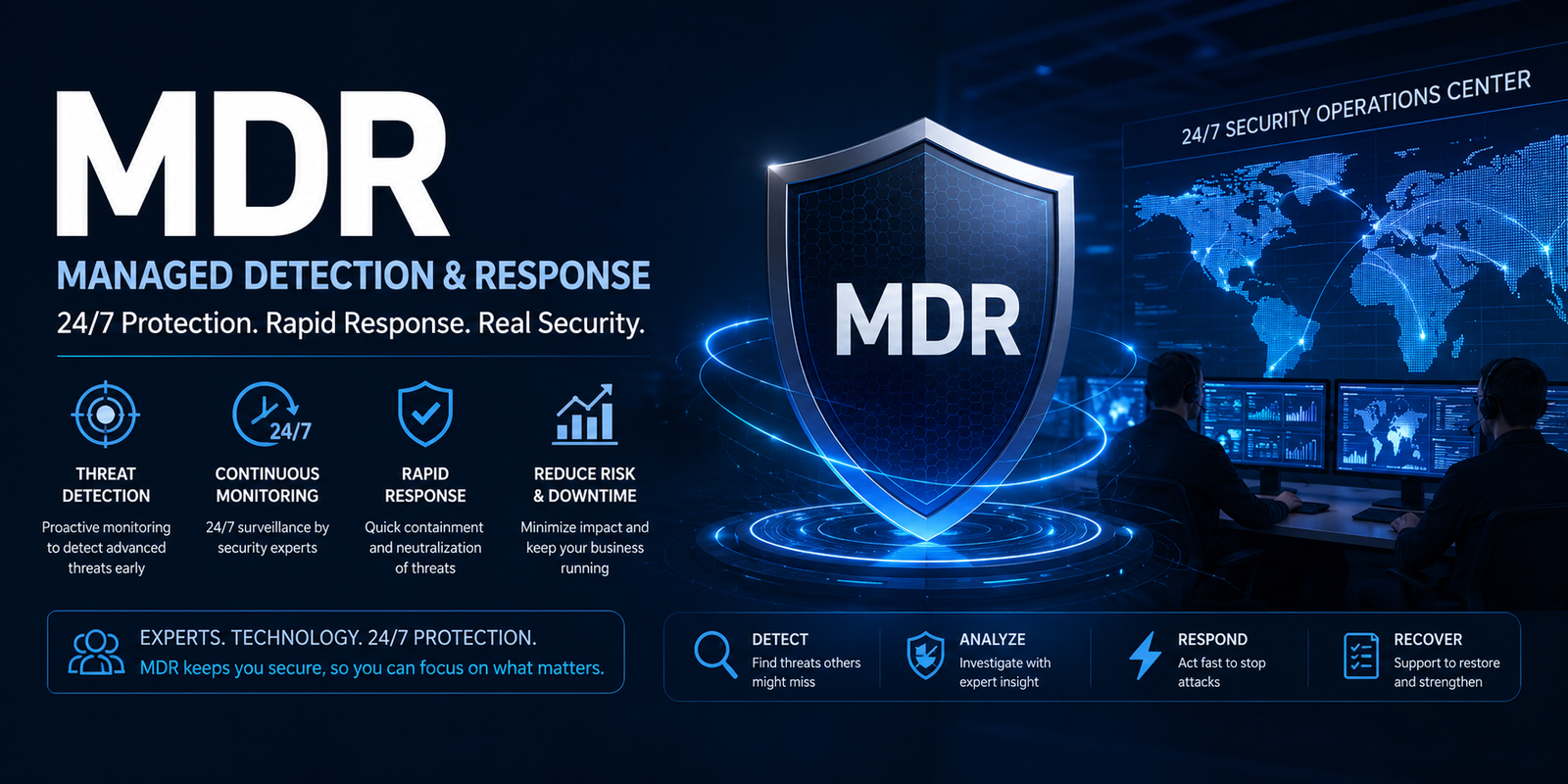
Cyberattacks are becoming faster, more sophisticated, and harder for security teams to monitor around the clock. Businesses may have firewalls, endpoint protection, SIEM platforms, and other security tools, yet still struggle with alert overload, limited visibility, and a shortage of cybersecurity professionals. This is where MDR cybersecurity services can make a significant difference.
MDR stands for Managed Detection and Response. It is a cybersecurity service that combines continuous monitoring, threat detection, investigation, threat hunting, and incident response with security expertise. Instead of simply providing another security tool, an MDR provider helps organizations identify and respond to suspicious activity before an attack causes greater damage.
This guide explains MDR meaning, how MDR works, what services include, its benefits, common use cases, pricing factors, and how it compares with EDR, XDR, MSSP, and SIEM solutions.
What Is MDR?
MDR means Managed Detection and Response. It is a managed cybersecurity service designed to detect, investigate, and respond to threats across an organization's digital environment.
An MDR service typically combines security technologies with human security analysts. These experts continuously review security signals, investigate suspicious behavior, perform threat hunting, and help contain or remediate confirmed incidents.
The goal isn't simply to generate more alerts. Effective MDR focuses on finding meaningful threats, understanding their context, and helping organizations respond quickly.
How MDR Differs From Traditional Security Tools
Traditional security tools can identify suspicious activity, but organizations still need people to interpret alerts and decide what action to take. MDR adds that operational layer.
For example, an endpoint security platform might flag unusual PowerShell activity. An MDR team can investigate whether the activity is legitimate, determine whether it relates to a larger attack, identify affected systems, and recommend or perform appropriate response actions.
How Does MDR Work?
MDR generally follows a continuous security operations lifecycle.
Continuous Security Monitoring
MDR teams monitor security telemetry from sources such as endpoints, networks, cloud environments, identity systems, and applications.
Continuous monitoring helps identify unusual behavior that could indicate an active compromise.
Threat Detection and Alert Triage
Detection technologies generate alerts based on suspicious behavior, known threats, or unusual activity. Security analysts then prioritize these alerts.
This human review helps reduce alert fatigue and prevents security teams from wasting time investigating every low-risk notification.
Investigation and Threat Hunting
MDR analysts investigate suspicious activity to determine what happened, which systems are affected, and whether the activity represents a genuine threat.
Threat hunting goes one step further. Instead of waiting for alerts, analysts proactively search for indicators of compromise and unusual behaviors that automated detection may have missed.
Incident Response and Remediation
When a serious threat is confirmed, the MDR team can help contain it. Depending on the service agreement, response actions may include isolating an endpoint, disabling compromised accounts, removing malware, or eliminating persistence mechanisms.
After containment, analysts can investigate the root cause and provide recommendations to prevent similar incidents.
What Does an MDR Service Include?
The exact capabilities vary by provider, but comprehensive MDR services commonly include:
Organizations should always verify what is actually included in a provider's service rather than assuming every MDR offering provides the same level of monitoring and response.
Benefits of MDR Cybersecurity Services
24/7 Security Monitoring
A major advantage of MDR is continuous monitoring. Maintaining an internal security operation around the clock can require significant staffing, technology, and operational resources.
MDR can provide access to security professionals without requiring an organization to build an entire 24/7 SOC internally.
Faster Detection and Response
Attackers can move quickly after gaining access to an environment. MDR helps organizations reduce the time between suspicious activity, investigation, and response.
Two useful metrics are Mean Time to Detect (MTTD) and Mean Time to Respond (MTTR). Organizations can use these metrics to evaluate the effectiveness of their security operations.
Access to Security Expertise
Cybersecurity skills are in high demand. Smaller organizations may not have dedicated threat hunters, incident responders, or security analysts.
An MDR service can supplement internal staff with specialized expertise.
Reduced Alert Fatigue
Security products can generate large numbers of alerts. MDR analysts help prioritize and investigate meaningful events, allowing internal teams to focus on higher-value security activities.
Better Security Visibility
MDR can bring together security information from multiple environments, helping organizations identify attack patterns that may not be obvious when each security tool is viewed independently.
MDR Use Cases
MDR isn't limited to one type of cyberattack. It can support many security scenarios.
Ransomware Detection
Suppose an employee accidentally opens a malicious attachment. The malware begins modifying files and communicating with an unusual external system.
An MDR team can investigate the behavior, identify affected endpoints, isolate compromised systems, and help determine how the attack started.
Phishing and Account Compromise
MDR can help identify unusual authentication activity, suspicious account behavior, or signs that stolen credentials are being abused.
Endpoint Malware
If an endpoint begins executing suspicious processes, MDR analysts can investigate the activity and determine whether it is legitimate software or malware.
Cloud Security
As businesses increasingly use cloud infrastructure, MDR services can help monitor suspicious cloud activity, compromised credentials, unusual access patterns, and other potential threats.
Small Security Teams
A company with only a few security employees may struggle to provide 24/7 monitoring and advanced threat hunting. MDR can extend the capabilities of that team without requiring a complete internal SOC.
MDR vs EDR: What's the Difference?
One of the most common questions is MDR vs EDR.
EDR stands for Endpoint Detection and Response. It is a security technology designed primarily to monitor and protect endpoints such as laptops, desktops, and servers.
MDR, by contrast, is a managed service that uses security technologies alongside human expertise to detect and respond to threats.
The two aren't necessarily competitors. An MDR provider may actually use EDR software as one component of its overall service.
MDR vs XDR, MSSP, and SIEM
MDR is also frequently confused with other cybersecurity technologies and services.
XDR, or Extended Detection and Response, is a technology approach that correlates security signals across multiple environments. MDR is the managed service that can use XDR and other technologies.
MSSP, or Managed Security Service Provider, generally refers to a broader category of outsourced security services. Some MSSPs provide MDR capabilities, but the scope of an MSSP can extend beyond threat detection and response.
SIEM, or Security Information and Event Management, collects and analyzes security data. MDR adds managed monitoring, investigation, threat hunting, and response expertise around security technologies.
Understanding these distinctions helps businesses avoid selecting a service based solely on similar-sounding terminology.
MDR Software: Is It a Product or a Service?
The phrase MDR software can be confusing because MDR itself is generally a managed service rather than a single software application.
An MDR provider may use multiple technologies, including:
EDR platforms
XDR platforms
SIEM systems
Security analytics
Threat intelligence
Automation and orchestration tools
The provider's analysts use these technologies to monitor activity, investigate threats, and coordinate responses.
Therefore, when comparing MDR solutions, organizations should evaluate both the technology stack and the human services behind it.
How Much Does MDR Cost?
There isn't one universal MDR price. Costs depend on the organization's environment and the scope of service.
Common pricing factors include:
Number of endpoints
Number of users
Security data volume
Cloud and network coverage
Monitoring requirements
Threat-hunting capabilities
Incident-response services
Integration requirements
Contract length
Service-level agreements
Rather than focusing only on the cheapest provider, businesses should compare what each service actually includes.
A low-cost service with limited monitoring may provide less value than a more comprehensive service that includes human threat hunting and active incident response.
When Does a Business Need MDR?
MDR may be a good option for organizations that:
Cannot operate a 24/7 security operation
Have a small cybersecurity team
Experience excessive security alerts
Need advanced threat-hunting expertise
Want faster incident response
Use multiple security technologies
Need additional security coverage
Want to supplement an existing SOC
MDR isn't automatically necessary for every organization. Businesses should first evaluate their existing security capabilities, risk profile, staffing, technology, compliance requirements, and response needs.
How to Choose an MDR Company
Choosing the right MDR company requires more than comparing marketing claims.
Ask potential providers:
Is monitoring genuinely available 24/7?
What environments are covered?
Is threat hunting performed by human analysts?
What happens when a critical threat is detected?
Can the provider isolate endpoints or disable accounts?
What response actions require customer approval?
Which EDR, SIEM, and cloud platforms are supported?
What are the MTTD and MTTR commitments?
What reporting is provided?
How is customer data protected?
What exactly is included in the contract?
A strong MDR provider should clearly explain its detection process, escalation procedures, response capabilities, technology integrations, and service-level commitments.
MDR SLA and Important Metrics
An MDR service-level agreement should clearly define responsibilities and expectations.
Important areas include monitoring availability, critical incident notification, escalation procedures, response times, reporting, and remediation responsibilities.
Organizations should also monitor metrics such as MTTD, MTTR, incident volume, false-positive rates, detection coverage, and remediation completion.
The goal is to measure security outcomes rather than simply counting how many alerts an MDR provider processes.
MDR Limitations and Challenges
MDR can strengthen security operations, but it isn't a complete replacement for every internal security function.
Potential challenges include vendor dependency, integration complexity, privacy concerns, incomplete telemetry, response authorization limitations, contract restrictions, and costs.
An MDR provider can only detect what it has sufficient visibility to observe. Organizations should therefore ensure critical systems and relevant security data are properly integrated into the service.
MDR in Medical, MDR Gun, and Other Meanings
The acronym MDR has meanings outside cybersecurity. Search results can sometimes become confusing because the same abbreviation appears in unrelated industries.
For example, MDR in medical contexts can refer to different healthcare terms depending on the subject. MDR gun may refer to a firearm-related product or terminology rather than managed detection and response.
There is also MDR meaning French, where the meaning depends on the French context in which the abbreviation appears.
For cybersecurity searches, terms such as MDR cybersecurity, MDR services, managed detection and response, and MDR provider provide clearer context.
MDR and Microsoft
People sometimes search for MDR Microsoft when researching Microsoft's cybersecurity ecosystem and managed detection and response capabilities.
Microsoft offers security technologies and managed security-related services that can be part of a broader security operations strategy. However, organizations should distinguish a specific Microsoft security product or service from the general MDR category.
The important question is not simply whether a provider uses Microsoft technology, but whether the service delivers the monitoring, detection, investigation, threat hunting, and response capabilities the organization requires.
Conclusion
MDR provides organizations with a practical way to strengthen threat detection and response without necessarily building a fully staffed 24/7 security operation from scratch. By combining security technology with human analysts, threat hunting, investigation, and response, MDR cybersecurity services can help businesses detect threats faster and respond more effectively.
However, not all MDR services are identical. Organizations should carefully evaluate monitoring coverage, threat-hunting expertise, response capabilities, integrations, SLAs, pricing, reporting, and data protection before selecting an MDR company.
Ultimately, the best MDR service is one that fits the organization's environment, risk profile, security maturity, and response requirements rather than simply offering the longest list of features.
Frequently Asked Questions
What does MDR stand for in cybersecurity?
MDR stands for Managed Detection and Response. It is a managed cybersecurity service combining security monitoring, threat detection, investigation, threat hunting, and incident response.
What does an MDR service do?
An MDR service monitors security activity, investigates suspicious behavior, hunts for threats, prioritizes alerts, and helps organizations contain and remediate confirmed incidents.
Is MDR the same as EDR?
No. EDR is an endpoint security technology, while MDR is a managed service that can use EDR and other security technologies alongside human analysts.
Does MDR provide 24/7 monitoring?
Many MDR services provide 24/7 monitoring, but organizations should confirm monitoring hours and response commitments in the provider's service agreement.
How much does MDR cost?
MDR pricing varies based on factors such as endpoint count, data volume, coverage, integrations, response capabilities, and service requirements.
Can MDR replace an internal SOC?
MDR can supplement or partially replace some SOC capabilities, particularly for organizations that lack 24/7 staffing. Larger organizations may use MDR alongside an internal SOC.
Is MDR software?
MDR is primarily a managed cybersecurity service rather than a single software product. Providers may use EDR, XDR, SIEM, analytics, automation, and other technologies to deliver the service.
Leave a Reply