

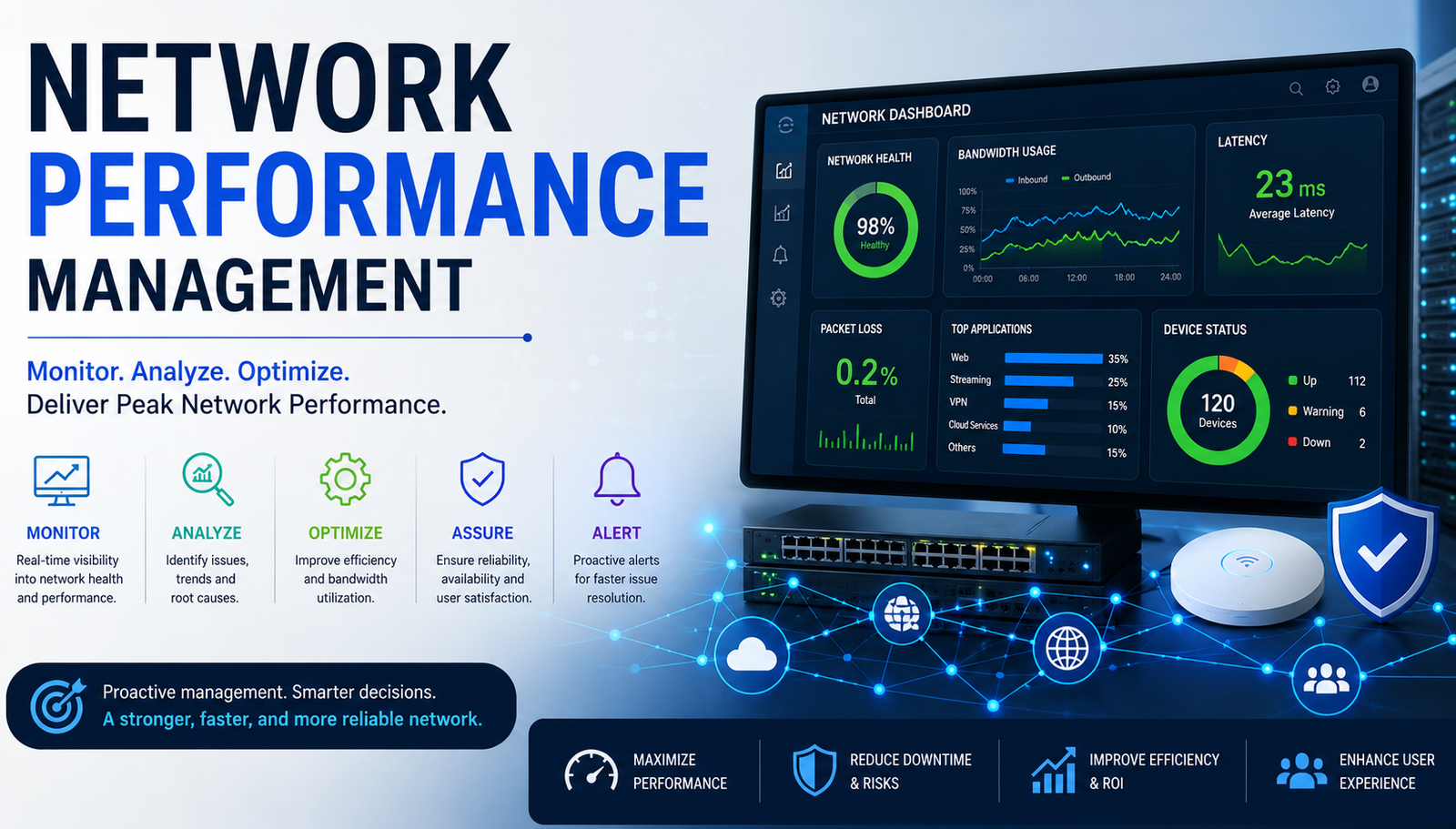
Modern businesses rely on fast, reliable, and secure networks to support daily operations. Whether employees work from the office, remotely, or in hybrid environments, network performance directly affects productivity, customer satisfaction, and business continuity. Even minor issues like high latency or packet loss can disrupt communication, slow applications, and increase operational costs.
This is where network performance management becomes essential. Rather than simply monitoring devices, it provides continuous visibility into network health, identifies performance bottlenecks, and helps IT teams resolve issues before they affect users. With the rise of cloud computing, IoT devices, and distributed workforces, organizations need proactive strategies to maintain optimal network performance.
In this guide, you'll learn what network performance management is, why it matters, how it works, the key metrics to monitor, common challenges, best practices, and the latest trends in AI-driven network optimization. You'll also discover practical network performance management examples, learn about popular network performance management tools, and understand why investing in network performance management training can help IT professionals build stronger, more resilient networks.
What Is Network Performance Management?
Network performance management (NPM) is the process of monitoring, analyzing, and optimizing a network's performance to ensure reliable connectivity, minimal downtime, and the best possible user experience. It combines continuous monitoring with proactive management to detect performance issues before they become critical problems.
Unlike basic network monitoring, which focuses on collecting performance data, network performance management goes a step further by analyzing trends, identifying root causes, and recommending or automating corrective actions. This proactive approach helps organizations maintain consistent service levels while supporting growing network demands.
Example
Imagine an online retailer experiencing slower website response times during a major sales event. A network performance management solution detects unusually high bandwidth usage, identifies the overloaded network segment, and alerts the IT team before customers begin abandoning their shopping carts.
Why Network Performance Management Is Important
Every organization depends on network reliability to keep applications, cloud services, and communication systems running efficiently. Without proper performance management, small issues can quickly grow into costly outages.
Key benefits include:
Improved application performance
Faster troubleshooting
Better user experience
Reduced network downtime
Greater visibility across hybrid environments
Lower operational costs
Improved compliance with service-level agreements (SLAs)
Enhanced security monitoring
For businesses with remote employees and cloud-based workloads, network performance management ensures that users receive consistent performance regardless of location.
How Network Performance Management Works
Effective network performance management follows a continuous cycle of monitoring, analysis, alerting, troubleshooting, and optimization.
Data Collection
The first step is gathering performance data from routers, switches, servers, firewalls, wireless access points, and cloud resources.
Common technologies include:
SNMP (Simple Network Management Protocol)
NetFlow
sFlow
IPFIX
Streaming telemetry
These technologies provide detailed information about network traffic, bandwidth usage, device health, and communication patterns.
Performance Analysis
Collected data is analyzed to identify trends and establish performance baselines. Instead of reacting only after failures occur, IT teams compare current performance with historical data to detect unusual behavior.
Performance analysis helps answer questions such as:
Is latency increasing?
Which applications consume the most bandwidth?
Which devices are overloaded?
Are network resources reaching capacity?
Automated Alerting
Modern network performance management platforms automatically notify administrators when predefined thresholds are exceeded.
Common alerts include:
High CPU utilization
Increased packet loss
Bandwidth congestion
Device failures
Network outages
Abnormal traffic spikes
AI-powered solutions can also identify anomalies that traditional threshold-based monitoring might miss.
Root Cause Analysis
Finding the true cause of a performance issue is often the most challenging task.
Rather than treating symptoms, network performance management correlates information from multiple devices to identify the underlying problem.
For example, slow application performance may actually result from:
DNS failures
Switch congestion
ISP latency
Misconfigured Quality of Service (QoS)
Firewall bottlenecks
Identifying the root cause significantly reduces Mean Time to Repair (MTTR).
Continuous Optimization
Network optimization never stops.
Administrators continuously:
Upgrade network hardware
Optimize routing
Adjust QoS policies
Increase bandwidth where needed
Balance workloads
Remove unnecessary traffic
This proactive approach keeps networks performing efficiently as business demands grow.
Key Network Performance Metrics You Should Monitor
Monitoring the right metrics allows organizations to detect performance issues early and maintain a healthy network.
Monitoring these metrics consistently enables organizations to detect problems before they affect users.
Network Performance Management vs. Network Monitoring vs. Network Management
Although these terms are often used interchangeably, they have different purposes.
Understanding these differences helps organizations select the right strategy for their IT environment.
Core Components of an Effective Network Performance Management Strategy
A successful network performance management program relies on several essential components working together.
Real-Time Monitoring
Continuous monitoring provides instant visibility into network health, allowing administrators to detect issues as soon as they occur.
Performance Baselines
Baselines represent normal network behavior. By comparing current performance with historical trends, IT teams can quickly identify unusual activity.
Automated Alerts
Automation reduces manual monitoring by notifying administrators whenever critical thresholds are exceeded.
AI and Predictive Analytics
Artificial intelligence analyzes historical network data to predict future problems before they impact users.
For example, AI may identify gradually increasing bandwidth utilization and recommend capacity upgrades before network congestion becomes noticeable.
Network Mapping
Visual network maps help administrators understand how devices are connected and quickly identify dependencies during outages.
Capacity Planning
Capacity planning ensures that networks can support future business growth without sacrificing performance.
Rather than waiting for resources to become overloaded, organizations use historical data to forecast future bandwidth and infrastructure requirements.
Reporting Dashboards
Interactive dashboards present performance data in an easy-to-understand format.
Common dashboard metrics include:
Network availability
Top bandwidth consumers
Device health
Traffic trends
Performance scores
Active alerts
These reports help both technical teams and business leaders make informed decisions.
SLA Monitoring
Organizations that provide network services often commit to Service Level Agreements (SLAs). Network performance management continuously measures uptime, latency, and response times to ensure these commitments are met.
Common Causes of Poor Network Performance
Even well-designed networks experience occasional performance issues. Understanding the most common causes helps IT teams resolve problems more quickly.
Some of the leading causes include:
Network congestion caused by excessive bandwidth usage
Outdated networking hardware
Misconfigured routers or switches
Poor Quality of Service (QoS) policies
Wireless interference
Faulty network cables
DNS resolution problems
ISP-related outages
Hardware failures
Malware or suspicious network activity
For example, a company may notice frequent video conferencing issues. Investigation reveals that large backup jobs are consuming most of the available bandwidth during business hours. By rescheduling backups to off-peak times and adjusting QoS settings, the organization restores smooth communication without upgrading its internet connection.
Best Practices for Network Performance Management
Following proven best practices helps organizations maintain reliable and high-performing networks while reducing downtime.
Some of the most effective practices include:
Continuously monitor network performance instead of relying on periodic checks.
Establish performance baselines to detect unusual behavior quickly.
Configure intelligent alerts to reduce unnecessary notifications.
Regularly update firmware and networking equipment.
Monitor both on-premises and cloud environments from a unified dashboard.
Review historical performance trends to identify recurring issues.
Perform routine capacity planning before network resources become overloaded.
Test disaster recovery and failover procedures regularly.
Document infrastructure changes to simplify troubleshooting.
Segment network traffic to improve performance and security.
Network Performance Optimization Checklist
Monitor latency, packet loss, and jitter daily.
Keep network devices updated with the latest firmware.
Review bandwidth usage reports weekly.
Remove unnecessary traffic and inactive devices.
Validate QoS policies for critical applications.
Schedule regular network health assessments.
Train IT teams on evolving networking technologies.
These practices create a proactive approach that minimizes outages and improves the overall user experience.
Network Performance Management in Different Environments
Modern businesses operate across multiple environments, including traditional offices, cloud platforms, remote locations, and data centers. Each environment creates unique performance challenges, making network performance management essential for maintaining reliable connectivity.
Enterprise Networks
Large organizations often manage thousands of devices, applications, and users across different locations. Network performance management helps IT teams maintain visibility, detect bottlenecks, and improve overall network efficiency.
Enterprise NPM solutions help with:
Monitoring multiple locations from a central dashboard
Tracking network availability and performance
Identifying bandwidth issues
Improving application response times
Supporting SLA requirements
For example, a global company may use network performance management to identify why employees in one regional office experience slower access to business applications compared to other locations.
Hybrid Cloud and Multi-Cloud Networks
Many organizations now use a combination of on-premises infrastructure and cloud services. While cloud adoption improves flexibility, it also makes network monitoring more complex.
Network performance management helps businesses monitor:
Cloud application performance
Data transfer speeds
Cloud connectivity issues
Network dependencies
Bandwidth usage
Without proper visibility, IT teams may struggle to determine whether slow performance is caused by internal infrastructure, internet connectivity, or cloud service providers.
Remote Workforce Networks
Remote work has increased the need for better visibility into user connectivity outside traditional office networks.
Network performance management helps organizations monitor:
VPN performance
Remote desktop connections
Video conferencing quality
Application response times
Home network connectivity
For example, if employees experience poor video call quality, NPM tools can identify whether the issue is related to network congestion, high latency, or insufficient bandwidth.
Data Centers
Data centers require high availability and consistent performance because they support critical applications and services.
Network performance management helps data center teams monitor:
Server communication
Network traffic patterns
Device health
Application dependencies
Resource utilization
This allows administrators to detect problems early and prevent service interruptions.
AI and Automation in Network Performance Management
Artificial intelligence has changed how organizations monitor and optimize networks. Traditional monitoring systems mainly rely on predefined rules, while AI-powered solutions can analyze large amounts of data and identify complex performance patterns.
Predictive Analytics
AI can analyze historical network data to predict future performance problems.
For example, if a network continuously shows increasing bandwidth consumption, AI can predict when capacity limits will be reached and recommend upgrades before users experience slowdowns.
Automated Root Cause Analysis
Finding the actual cause of a network problem can take hours when done manually. AI-powered network performance management systems analyze multiple data sources to identify the most likely cause.
For example:
A company notices slow application performance. The system analyzes:
Router performance
Server response time
Network traffic
Firewall activity
It discovers that a misconfigured routing rule is causing delays.
Intelligent Alert Management
Large networks can generate hundreds of alerts every day. Too many alerts can create alert fatigue and make it difficult for IT teams to focus on important issues.
AI helps by:
Prioritizing critical alerts
Removing duplicate notifications
Identifying abnormal activity
Suggesting possible solutions
Challenges of Network Performance Management
Although network performance management provides many advantages, organizations may face several challenges during implementation.
Limited Network Visibility
Modern networks include cloud services, IoT devices, remote users, and third-party applications. Monitoring all these components can be difficult.
Organizations can overcome this challenge by using centralized NPM platforms that provide complete visibility across different environments.
Alert Fatigue
Too many unnecessary alerts can reduce productivity and delay response times.
The solution is to configure smart thresholds and use automation to prioritize important incidents.
Multi-Vendor Network Complexity
Many organizations use networking equipment from different vendors, which can make monitoring complicated.
Choosing tools that support multiple vendors and standard protocols helps create a unified monitoring environment.
Lack of Skilled Professionals
Advanced network monitoring requires specialized knowledge. Organizations can improve their team's capabilities through network performance management training.
Training helps professionals understand:
Network performance metrics
Monitoring technologies
Troubleshooting techniques
Performance optimization methods
Modern NPM platforms
Network Performance Management Examples and Real-World Use Cases
Understanding practical applications helps explain the value of network performance management.
Healthcare Industry
Healthcare organizations depend on reliable networks for patient records, medical systems, and communication platforms.
Network performance management helps hospitals:
Reduce downtime
Maintain application availability
Monitor critical systems
Improve healthcare service delivery
Financial Services
Banks and financial institutions require fast and reliable networks because transaction delays can affect customer experience.
NPM solutions help monitor:
Transaction systems
Network latency
Application performance
Connectivity issues
E-Commerce Businesses
Online stores experience high traffic during promotions and seasonal sales. Network performance management helps businesses identify performance issues before customers are affected.
Common monitoring areas include:
Website response time
Server connectivity
Bandwidth usage
Application performance
Managed Service Providers
MSPs manage networks for multiple customers and require centralized monitoring capabilities.
Network performance management helps MSPs:
Monitor multiple client networks
Detect problems remotely
Provide faster support
Generate detailed reports
How to Choose the Right Network Performance Management Tools
Selecting the right solution depends on business requirements, network size, and technical goals.
Important features to consider include:
Popular categories of network performance management tools include:
Enterprise network monitoring platforms
Cloud-based monitoring solutions
Open-source network monitoring tools
AI-powered performance management platforms
MSP-focused monitoring solutions
Organizations should choose tools based on their infrastructure needs instead of selecting solutions only because they offer more features.
Common Mistakes to Avoid in Network Performance Management
Many organizations fail to achieve maximum benefits because of poor monitoring strategies.
Monitoring Only Device Availability
A device being online does not always mean the network is performing correctly. Applications may still suffer from latency, congestion, or configuration problems.
Ignoring Performance Baselines
Without knowing normal network behavior, identifying unusual activity becomes difficult.
Using Too Many Monitoring Tools
Multiple disconnected tools can create visibility gaps and increase management complexity.
Taking a Reactive Approach
Waiting until users report problems can increase downtime. A proactive monitoring strategy identifies issues before they impact business operations.
Neglecting Employee Training
Even advanced NPM solutions require skilled professionals. Regular network performance management training helps teams understand monitoring data and improve troubleshooting efficiency.
Conclusion
Network performance management plays a critical role in maintaining fast, reliable, and efficient networks. As businesses adopt cloud services, remote work, and complex digital infrastructures, proactive monitoring becomes more important than ever.
By using the right strategies, implementing effective network performance management tools, and investing in professional training, organizations can reduce downtime, improve user experience, and optimize network operations.
A strong NPM approach allows businesses to detect problems early, improve performance, and build a reliable infrastructure ready for future growth.
Frequently Asked Questions
What is Network Performance Management?
Network performance management is the process of monitoring, analyzing, and improving network performance to ensure reliable connectivity, better application performance, and reduced downtime.
How is Network Performance Management different from network monitoring?
Network monitoring focuses on detecting problems and checking device status, while network performance management analyzes data, identifies root causes, and improves overall network efficiency.
What metrics are important in Network Performance Management?
Important metrics include latency, packet loss, jitter, bandwidth utilization, throughput, availability, response time, and error rates.
What are the best Network Performance Management tools?
The best tools depend on business needs, but effective solutions usually provide real-time monitoring, automation, analytics, reporting, and cloud support.
Why is Network Performance Management training important?
Training helps IT professionals understand monitoring technologies, performance metrics, troubleshooting methods, and optimization strategies.
What are some Network Performance Management examples?
Examples include monitoring enterprise networks, improving cloud connectivity, optimizing video conferencing performance, managing data centers, and supporting MSP operations.
Leave a Reply