

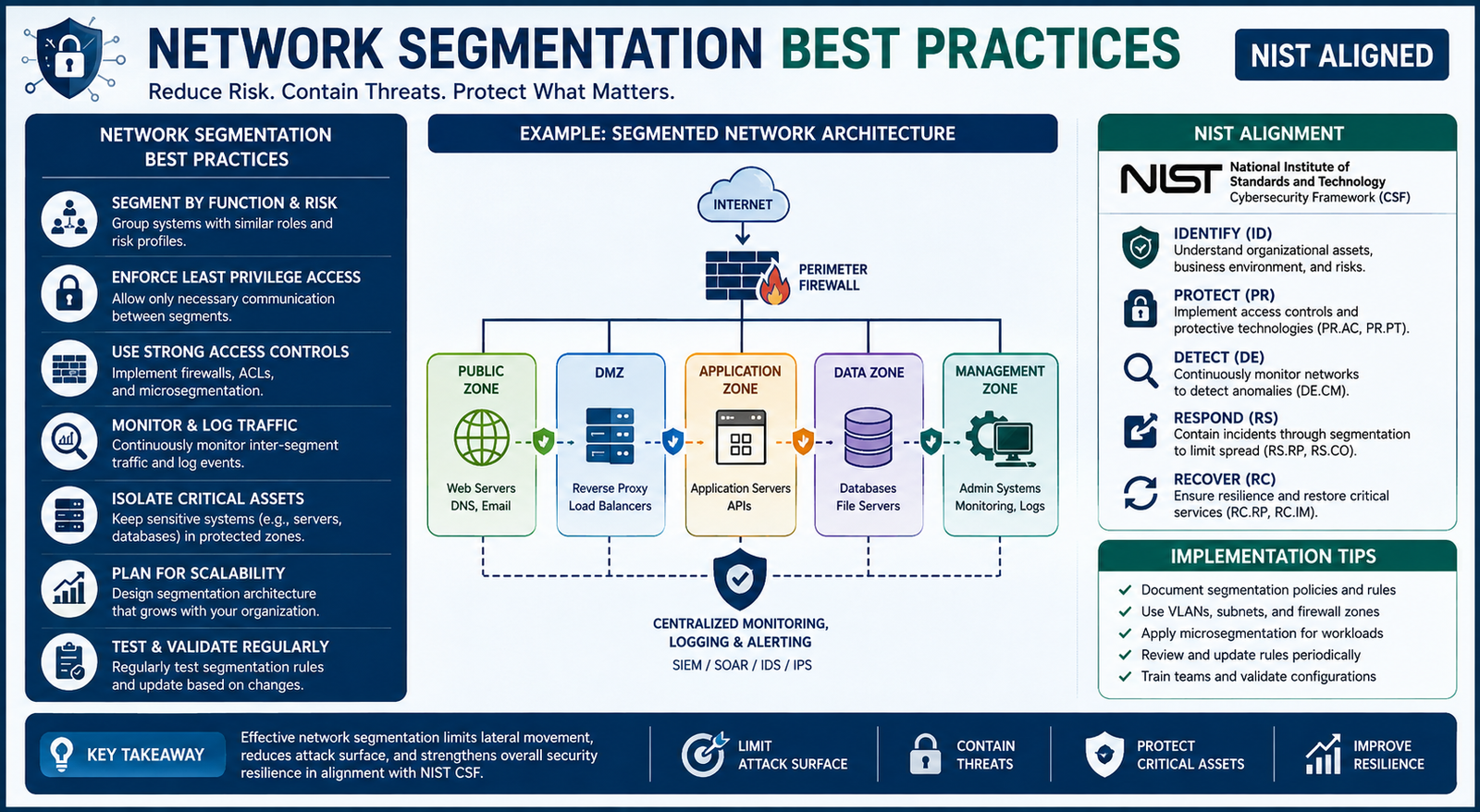
A flat network can turn one compromised device into a pathway to critical servers, applications, databases, and sensitive data. Network segmentation reduces that risk by dividing an environment into security zones and controlling the traffic allowed between them.
But effective segmentation is more than creating VLANs. The strongest network segmentation best practices NIST guidance combines asset visibility, risk-based zoning, least-privilege access, traffic controls, monitoring, testing, and continuous improvement.
NIST does not prescribe one universal network layout. Instead, its publications provide principles and guidance that organizations can apply according to their architecture and risk. NIST SP 800-215, for example, addresses today's distributed enterprise environment, including cloud services, microservices, microsegmentation, Zero Trust Network Access, and modern WAN security.
This guide explains how to translate those principles into a practical network segmentation strategy, with examples for enterprise, cloud, IoT, and OT environments.
What Is Network Segmentation?
Network segmentation is the practice of dividing a network into separate logical or physical zones and controlling communication between those zones. Common technologies include VLANs, subnets, firewalls, access control lists (ACLs), network access control (NAC), and microsegmentation.
The goal is not simply to create more networks. It is to ensure that users, devices, applications, and workloads can communicate only with the systems they actually need. This limits unnecessary connectivity and can reduce an attacker's ability to move laterally after an initial compromise.
For example, a company might separate employee devices, guest Wi-Fi, servers, databases, IoT devices, and management systems. A guest device may have internet access but no route to internal servers, while an application server may have tightly restricted access to a database.
What Does NIST Say About Network Segmentation?
NIST approaches segmentation as part of broader cybersecurity architecture and risk management rather than requiring a single segmentation model. The NIST Cybersecurity Framework (CSF) 2.0 provides high-level cybersecurity outcomes but explicitly does not prescribe exactly how organizations must achieve those outcomes.
Several NIST publications are particularly relevant when designing a modern segmentation strategy.
NIST SP 800-215
NIST SP 800-215, Guide to a Secure Enterprise Network Landscape, recognizes that enterprise environments have changed significantly because of cloud services, distributed infrastructure, multiple data centers, and microservices.
It discusses technologies and architectures including firewalls, microsegmentation, ZTNA, SASE, and cloud security. NIST also highlights network visibility and monitoring as important components of modern network security.
NIST SP 800-207 and Zero Trust
NIST SP 800-207 explains that Zero Trust does not grant implicit trust simply because a user or device is inside a particular network location. Instead, it focuses protection on users, assets, resources, and services.
That distinction matters because traditional segmentation and Zero Trust are complementary. Segmentation creates boundaries, while Zero Trust can apply more granular identity-, device-, and resource-based policies across and within those boundaries.
NIST SP 800-82 for OT
Organizations securing operational technology need additional considerations because OT environments have unique performance, reliability, and safety requirements. NIST SP 800-82 Rev. 3 provides guidance for environments such as industrial control systems, SCADA, building automation, transportation, and other cyber-physical systems.
Network Segmentation Best Practices Based on NIST Principles
1. Inventory and Classify Network Assets
Start by determining what actually exists on the network. Identify endpoints, servers, applications, databases, cloud workloads, IoT devices, network infrastructure, administrative systems, and critical OT assets.
Classification should consider business importance, data sensitivity, exposure, ownership, and risk. A database containing sensitive customer information should not automatically receive the same security treatment as a guest laptop.
2. Map Data Flows and Required Communications
Before creating zones, understand how systems communicate.
Document which users, applications, devices, and services need to communicate, including required ports and protocols. This prevents a common segmentation mistake: building arbitrary boundaries without understanding legitimate business dependencies.
For example:
Web server → application server: Allow required HTTPS traffic
Application server → database: Allow only required database traffic
Guest network → database: Deny
IoT network → employee endpoints: Deny unless specifically required
3. Create Security Zones Based on Risk
Security zones should reflect meaningful differences in trust, sensitivity, function, or criticality.
Typical zones include:
Internet-facing systems
DMZ
Employee endpoints
Application servers
Database servers
Guest devices
IoT devices
Management systems
Backup infrastructure
Security infrastructure
For OT environments, segmentation decisions may also consider functional criticality, data flows, trust relationships, management authority, and physical location.
4. Enforce Least-Privilege Communication
Segmentation becomes much more effective when communication between zones follows least-privilege principles.
Instead of asking, “Which networks can talk to each other?” ask:
“What exact communication is required for this business function?”
Where appropriate, organizations can use restrictive policies that deny unnecessary traffic and permit only approved connections. This reduces the number of pathways available for lateral movement.
5. Use VLANs, Subnets, Firewalls, and ACLs Together
A VLAN by itself should not be treated as a complete security strategy.
For example, putting payment systems in a separate VLAN is useful, but firewall rules, access controls, monitoring, and administrative restrictions should also protect that zone.
6. Separate High-Risk and Critical Systems
Prioritize systems whose compromise would have significant consequences.
These may include:
Domain controllers
Databases
Backup servers
Payment systems
Security management systems
Administrative workstations
Critical applications
OT/ICS systems
A compromised employee workstation should not automatically provide a direct path to a domain controller or sensitive database.
7. Control East-West Traffic
North-south traffic moves between internal and external environments. East-west traffic moves between systems inside the environment.
This distinction is important because attackers often attempt lateral movement after gaining an initial foothold.
Monitoring and restricting east-west connections can therefore reduce the number of systems an attacker can reach. NIST's modern enterprise guidance recognizes the increasing complexity of interconnected environments and the importance of security capabilities such as visibility and monitoring.
8. Apply Zero Trust Principles Where Appropriate
Network segmentation, microsegmentation, and Zero Trust are related but different.
Network segmentation creates larger security boundaries.
Microsegmentation creates more granular boundaries around workloads, applications, or workloads.
Zero Trust changes the access model by removing implicit trust and requiring appropriate authentication and authorization.
NIST SP 800-207 states that Zero Trust focuses on protecting resources rather than treating network location as the primary security boundary.
9. Extend Segmentation to Cloud and Hybrid Environments
Modern segmentation cannot stop at the corporate LAN.
Cloud environments may use virtual networks, security groups, network security groups, cloud firewalls, routing controls, Kubernetes network policies, and identity-aware controls.
NIST SP 800-215 specifically addresses the transformation caused by cloud services, distributed IT resources, and microservices.
For cloud-native applications, NIST SP 800-207A also describes the use of network-tier and identity-tier policies for granular access control across multi-cloud and hybrid environments.
10. Monitor and Log Inter-Segment Traffic
A segmentation policy is only as effective as your ability to determine whether it is working.
Monitor:
Firewall events
Denied connections
Unexpected east-west traffic
New communication paths
Authentication events
Network flows
IDS/IPS alerts
Security analytics
Send relevant security events to centralized monitoring or a SIEM where appropriate. Unexpected communication between normally isolated zones can provide an important signal of misconfiguration or malicious activity.
11. Test Segmentation Regularly
Don't assume segmentation works because the configuration looks correct.
Test whether unauthorized traffic is actually blocked. Depending on the environment, validation may include configuration reviews, vulnerability assessments, penetration testing, attack simulations, and controlled connection tests.
For example, if the guest VLAN is supposed to have no access to internal servers, test that assumption from the guest network rather than simply reviewing the firewall rule.
12. Document Exceptions and Review Rules
Business requirements sometimes require exceptions. The problem occurs when temporary exceptions become permanent.
Document:
What access is permitted
Why it is required
Who approved it
Which systems are affected
Who owns the rule
When it should expire
Review segmentation after major infrastructure, application, cloud, or business changes.
Network Segmentation vs Microsegmentation vs Zero Trust
These terms are often used interchangeably, but they solve different problems.
A mature security architecture can use all three. Traditional segmentation can establish broad zones, microsegmentation can tighten internal workload communication, and Zero Trust can add identity and resource-aware access decisions.
Example of a NIST-Aligned Network Segmentation Architecture
Consider a company with public applications, employees, IoT devices, databases, and administrative systems.
A simplified architecture could look like this:
Internet → Firewall → DMZ → Web Tier → Application Tier → Database Zone
Separate controls can protect:
Employee VLAN
Guest VLAN
IoT VLAN
Management network
Backup infrastructure
Security systems
A basic policy could be:
This is not a mandatory NIST architecture. It is an example of how risk-based segmentation principles can be translated into practical controls. NIST CSF 2.0 deliberately does not prescribe how organizations must achieve its cybersecurity outcomes.
Network Segmentation for Different Environments
Small Businesses
Small organizations can start with meaningful separation rather than building an unnecessarily complex architecture. Guest Wi-Fi, employee systems, administrative devices, and critical servers are common starting points.
Enterprise Networks
Large organizations may require multiple security zones, data-center segmentation, identity-aware policies, microsegmentation, centralized monitoring, and formal change management.
IoT Environments
IoT devices often have different security characteristics from managed employee endpoints. Separating them can reduce the potential impact of a compromised device.
OT and ICS Networks
OT segmentation must balance cybersecurity with availability, reliability, safety, and operational requirements. NIST SP 800-82 Rev. 3 specifically addresses these unique OT considerations.
Common Network Segmentation Mistakes to Avoid
One of the biggest mistakes is assuming that VLANs automatically equal security. VLANs can provide logical separation, but effective security requires appropriate enforcement and monitoring.
Other common mistakes include:
Creating zones without mapping data flows
Allowing overly broad firewall rules
Ignoring east-west traffic
Forgetting guest and IoT devices
Leaving excessive firewall exceptions
Ignoring cloud workloads
Failing to monitor denied traffic
Never testing segmentation
Not documenting rule ownership
Failing to update policies after infrastructure changes
How to Implement Network Segmentation Step by Step
A practical implementation process can follow this sequence:
Inventory assets and identify unknown devices.
Classify systems and data according to business risk.
Map communication flows and application dependencies.
Identify trust boundaries and high-value assets.
Design security zones around meaningful risk differences.
Define permitted communications using least-privilege principles.
Choose enforcement technologies such as firewalls, ACLs, NAC, or microsegmentation.
Implement gradually to reduce operational disruption.
Monitor traffic between segments.
Test controls to confirm that unauthorized paths are blocked.
Document exceptions and assign ownership.
Continuously review policies as the environment changes.
The important point is that segmentation should be risk-driven rather than copied from a generic network diagram.
Network Segmentation and Security Frameworks
Network segmentation can support broader cybersecurity programs involving NIST CSF 2.0, NIST SP 800-207, NIST SP 800-53, PCI DSS, ISO 27001, and other security frameworks.
However, compliance language should be used carefully. NIST CSF 2.0 is not a prescriptive checklist. NIST describes it as a taxonomy of high-level cybersecurity outcomes and points organizations toward additional resources for achieving those outcomes.
Therefore, organizations should map their actual segmentation controls to the requirements applicable to their environment instead of assuming that one segmentation design automatically satisfies every framework.
Network Segmentation Checklist
Inventory network assets
Classify sensitive systems and data
Map application and data flows
Define security zones
Separate critical systems
Restrict unnecessary inter-zone traffic
Apply least-privilege access
Monitor east-west traffic
Centralize relevant security logs
Review firewall and ACL rules
Test segmentation controls
Document exceptions
Extend controls to cloud workloads
Review segmentation after major changes
Conclusion
Effective network segmentation best practices NIST are built around a simple principle: give systems only the connectivity they actually need.
Start with asset visibility and data-flow mapping, create risk-based security zones, enforce least-privilege communication, and protect critical systems with appropriate controls. Then extend those principles into cloud, IoT, and OT environments, monitor east-west traffic, and test the controls regularly.
The strongest segmentation strategy is not necessarily the one with the most VLANs. It is the one that creates meaningful security boundaries, limits unnecessary communication, and continues to adapt as the organization and its threat landscape change.
FAQs
What are NIST network segmentation best practices?
The main principles include asset identification, risk-based security zones, data-flow mapping, least-privilege communication, traffic enforcement, monitoring, testing, and continuous review. NIST provides related guidance across publications rather than prescribing one universal network layout.
Does NIST require network segmentation?
NIST does not prescribe one universal segmentation architecture. CSF 2.0 provides cybersecurity outcomes rather than specifying exactly how organizations must achieve them.
Which NIST publication covers network segmentation?
NIST SP 800-215 is especially relevant to modern enterprise network architecture and discusses technologies including microsegmentation, ZTNA, cloud security, and network visibility. SP 800-207 and SP 800-82 are also important for Zero Trust and OT environments.
Is a VLAN enough for network segmentation?
Not necessarily. VLANs provide logical separation, but strong segmentation generally requires appropriate traffic enforcement, access controls, monitoring, and validation.
What is the difference between network segmentation and microsegmentation?
Network segmentation typically creates broader zones such as employee, guest, and server networks. Microsegmentation applies more granular policies between individual workloads, applications, or services.
How does Zero Trust relate to network segmentation?
Segmentation creates boundaries, while Zero Trust removes implicit trust and evaluates access to resources based on appropriate identity, device, and policy information. NIST SP 800-207 emphasizes protecting resources rather than relying primarily on network location.
What should be segmented first?
Start with high-value, sensitive, critical, externally exposed, or poorly trusted systems. Prioritize based on business impact and risk rather than simply creating as many segments as possible.
Leave a Reply