

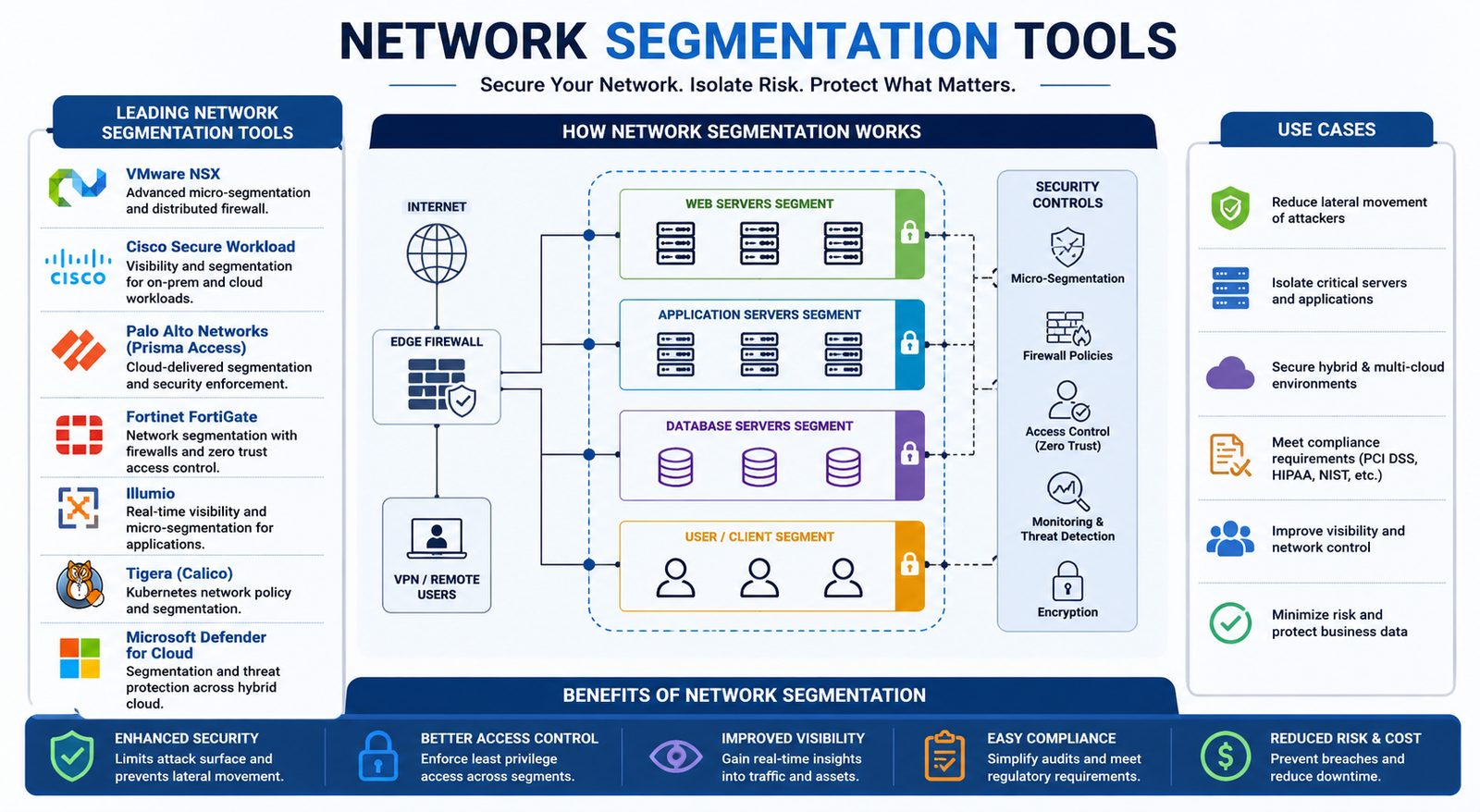
Modern organizations rarely operate from one simple network. Employees use cloud applications, servers communicate across data centers, and IoT, OT, and other connected devices introduce additional security risks. If one device is compromised, attackers may attempt to move laterally toward more valuable systems.
Network segmentation tools help reduce that risk by dividing environments into controlled security zones and enforcing rules about which users, devices, workloads, and applications can communicate. Modern platforms can go beyond traditional VLANs and firewalls by providing asset discovery, traffic visibility, microsegmentation, automated policies, and support for hybrid environments.
This guide explains how segmentation tools work, compares leading options, and shows what to consider before choosing a solution.
What Are Network Segmentation Tools?
Network segmentation tools are security solutions that separate a network into smaller logical or physical areas and control communication between them. The objective is to limit unnecessary access and prevent a compromise in one part of the environment from spreading throughout the organization.
Traditional segmentation can use VLANs, subnets, access control lists (ACLs), and firewalls. Modern network segmentation software can add identity-aware policies, workload-level controls, automated discovery, and continuous monitoring.
For example, a company could isolate its employee devices from database servers while placing guest Wi-Fi, security cameras, payment systems, and industrial equipment into separate segments. If an employee laptop becomes infected, segmentation can prevent the attacker from automatically reaching sensitive systems.
How Do Network Segmentation Tools Work?
Most segmentation platforms follow a similar security workflow.
1. Discover assets and connections
The tool identifies devices, servers, applications, workloads, and communication relationships. Good visibility is important because organizations cannot create effective policies for assets they do not understand.
2. Map network traffic
The platform analyzes traffic flows to determine which systems need to communicate. This is particularly important for east-west traffic moving between internal workloads.
3. Create segmentation policies
Security teams define permitted communication based on factors such as identity, device type, application, workload, location, or business function.
4. Enforce the policies
Depending on the platform, enforcement can happen through endpoint agents, network infrastructure, firewalls, cloud controls, hypervisors, or other enforcement points.
5. Monitor and adjust
Segmentation is not a one-time configuration. Networks change, applications move, and new devices appear. Continuous monitoring helps security teams identify policy problems and unnecessary access.
Best Network Segmentation Tools in 2026
There is no universally best platform. The right choice depends on your architecture, device types, cloud footprint, compliance requirements, and whether you need traditional segmentation or granular microsegmentation.
Current market coverage includes platforms such as Illumio, Akamai Guardicore, Cisco, ColorTokens, Elisity, Zero Networks, Zscaler, VMware, and other network-native solutions. Gartner's 2026 market overview also emphasizes that microsegmentation can provide finer-grained zoning across public, private, and hybrid cloud environments.
1. Illumio
Illumio is a strong option for organizations looking for enterprise microsegmentation and breach-containment capabilities. It focuses on understanding application communication and applying granular policies across hybrid environments.
It is particularly relevant for organizations with large, heterogeneous infrastructures that need centralized visibility and workload-level controls. Current third-party coverage continues to position Illumio among the leading microsegmentation platforms.
Best for: Large enterprises and workload microsegmentation.
2. Akamai Guardicore Segmentation
Akamai Guardicore is designed for granular segmentation across data centers, cloud, and hybrid environments. Its focus on application-flow visibility can help security teams understand how systems communicate before enforcing restrictive policies.
Best for: Complex enterprise and hybrid infrastructures.
3. Cisco Secure Workload
Cisco Secure Workload provides workload-level segmentation and is particularly attractive to organizations already invested in the Cisco ecosystem.
It can help security teams define policies around application communication rather than relying exclusively on traditional network boundaries.
Best for: Cisco-centric enterprise environments.
4. ColorTokens
ColorTokens provides a Zero Trust-oriented approach to segmentation with support for different enforcement models. It can be considered by organizations that need segmentation across diverse infrastructure rather than a single network architecture.
Best for: Enterprise Zero Trust and flexible deployment requirements.
5. Elisity
Elisity takes an identity-based, agentless approach to segmentation. This can be useful when organizations need to secure unmanaged, IoT, OT, or other devices where installing endpoint software may not be practical.
Its identity-driven model is particularly relevant for environments that need to use existing network infrastructure as an enforcement point. Current 2026 market coverage includes Elisity among leading microsegmentation solutions.
Best for: Agentless segmentation and environments containing unmanaged devices.
6. Zero Networks
Zero Networks focuses on automated, agentless segmentation and uses automated discovery and policy creation to reduce manual segmentation work.
Its approach can be attractive to organizations that want to introduce segmentation without deploying traditional endpoint agents across every system. Zero Networks was also recognized in the 2026 GigaOm Radar for its identity-driven microsegmentation and automated policy generation.
Best for: Organizations prioritizing rapid, agentless segmentation.
7. Zscaler
Zscaler is primarily associated with cloud-delivered Zero Trust security rather than traditional network segmentation. However, its broader Zero Trust architecture can address segmentation-related access requirements for users, applications, and workloads.
Best for: Cloud-first organizations building a broader Zero Trust architecture.
8. VMware vDefend
VMware vDefend is relevant to organizations heavily invested in VMware infrastructure. Hypervisor-based security controls can provide segmentation without requiring the same endpoint deployment model as host-based solutions.
Best for: VMware-based data centers and virtualized environments.
9. Forescout
Forescout is especially relevant where device visibility and network access control are major priorities. It can help organizations identify connected devices and enforce security policies around them.
This makes it useful in environments containing large numbers of endpoints, IoT devices, and other connected assets.
Best for: Device discovery, NAC, and device-heavy environments.
10. ORDR
ORDR focuses heavily on agentless segmentation and environments containing medical devices, IoT, OT, and legacy technology. Its current comparison methodology emphasizes legacy-device compatibility, deployment speed, automation, and integration.
Best for: Healthcare, medical devices, OT, and legacy environments.
Network Segmentation vs Microsegmentation
Traditional network segmentation generally creates larger security zones using technologies such as VLANs, subnets, ACLs, and firewalls. Microsegmentation provides more granular controls, potentially down to individual workloads, applications, or assets.
Microsegmentation is closely associated with Zero Trust, but the two terms should not be treated as synonyms. NIST's Zero Trust Architecture focuses on protecting resources rather than automatically trusting users or devices because of their network location.
Agent-Based vs Agentless Network Segmentation
One of the most important decisions when evaluating segmentation software is whether endpoints need an agent.
Agent-based tools can provide deep visibility and granular workload controls, but they require software deployment and ongoing agent management. This may be difficult for unsupported operating systems, legacy technology, or certain IoT and OT devices.
Agentless tools can reduce endpoint deployment requirements and may be better suited to unmanaged or specialized devices. However, capabilities vary significantly between vendors, so buyers should verify exactly where policies are enforced.
A practical approach is to inventory your environment first. If a significant percentage of your assets cannot run agents, an agentless or network-native solution may deserve greater consideration.
Network Segmentation Tools for Different Use Cases
Enterprise Networks
Enterprises can use segmentation to separate employee endpoints, servers, databases, privileged systems, and business-critical applications.
Healthcare
Healthcare environments often contain medical and IoMT devices that cannot always support traditional endpoint security software. Segmentation can isolate these devices while limiting unnecessary communication with clinical and administrative systems.
Manufacturing and OT
Industrial environments need special consideration because segmentation must protect PLCs, SCADA systems, engineering workstations, and other operational technology without disrupting production.
IoT
IoT devices frequently have limited security capabilities. Separating cameras, sensors, smart devices, and other connected equipment can reduce the potential blast radius of a compromise.
Cloud and Hybrid Networks
Modern segmentation must increasingly address cloud workloads, containers, and hybrid infrastructure. Gartner notes that microsegmentation technologies can provide finer-grained zoning across public, private, and hybrid cloud environments.
What Features Should You Look For?
When comparing network segmentation tools, focus on capabilities rather than marketing claims.
Look for:
Asset discovery and classification
Network traffic visibility
Microsegmentation
Identity-based policies
Agentless deployment options
Legacy-device support
Cloud and hybrid compatibility
IoT and OT support
Policy automation
SIEM and EDR integrations
Compliance reporting
Scalability
Policy simulation and testing
A proof of concept is particularly valuable. Test whether the platform can discover your real environment, build useful policies, and enforce them without disrupting legitimate business traffic.
Common Network Segmentation Mistakes
A segmentation project can fail even when the technology is capable.
One common mistake is creating too many segments without understanding actual communication requirements. Another is focusing only on north-south traffic while ignoring east-west communication between internal systems.
Organizations may also forget legacy devices, fail to review policies regularly, or treat segmentation as a replacement for other security controls.
Segmentation should work alongside identity security, endpoint protection, vulnerability management, monitoring, and incident response.
How to Choose the Right Tool
Start by documenting your environment. Identify endpoints, servers, cloud workloads, IoT devices, OT systems, and critical applications.
Next, define the security objective. You may want to reduce ransomware lateral movement, protect payment systems, meet compliance requirements, implement Zero Trust, or isolate legacy devices.
Then compare enforcement models, integrations, automation, scalability, and operational complexity.
Finally, run a controlled proof of concept. A tool that looks excellent on paper may not be the best fit for your specific network.
Conclusion
Network segmentation is no longer limited to creating VLANs and firewall zones. Modern network segmentation tools can provide asset discovery, traffic analysis, granular policy enforcement, microsegmentation, automation, and support for cloud, IoT, OT, and hybrid environments.
The best solution is not necessarily the tool with the longest feature list. Start with your environment and security objectives, determine whether you need agent-based or agentless enforcement, and test shortlisted platforms against real traffic and operational requirements.
For many organizations, the most valuable segmentation platform will be the one that can create effective least-privilege policies without breaking legitimate business communication.
Frequently Asked Questions
What are network segmentation tools?
Network segmentation tools are security solutions that divide environments into controlled zones and enforce communication policies between users, devices, applications, and workloads. Modern platforms can provide visibility, automation, and microsegmentation in addition to traditional controls.
What are the best network segmentation tools?
Leading options include Illumio, Akamai Guardicore, Cisco Secure Workload, ColorTokens, Elisity, Zero Networks, Zscaler, VMware vDefend, Forescout, and ORDR. The best choice depends on your infrastructure, device types, deployment requirements, and security goals. Current 2026 market comparisons also distinguish between workload-based, identity-based, network-native, and cloud-oriented approaches.
Are VLANs network segmentation tools?
VLANs are a network segmentation technology rather than a complete modern segmentation platform. They can separate network zones, but dedicated tools may add centralized visibility, automated policy management, identity-based controls, and microsegmentation.
What is the difference between segmentation and microsegmentation?
Traditional segmentation generally separates larger network zones, while microsegmentation applies more granular controls to individual workloads, applications, devices, or communication flows.
Are agentless network segmentation tools better?
Not necessarily. Agentless solutions can be advantageous for legacy, IoT, and OT environments, while agent-based platforms may provide deeper workload-level visibility and control. The correct choice depends on the devices and infrastructure you need to protect.
Can network segmentation tools support Zero Trust?
Yes. Segmentation and microsegmentation can support Zero Trust by enforcing least-privilege communication between resources. However, segmentation alone does not constitute a complete Zero Trust architecture.
Are free network segmentation tools available?
Some individual segmentation technologies, firewall capabilities, open-source networking tools, and native cloud controls can be used without purchasing a dedicated enterprise platform. However, advanced capabilities such as centralized discovery, automated policy generation, enterprise support, and large-scale microsegmentation are commonly associated with commercial solutions.
Leave a Reply