

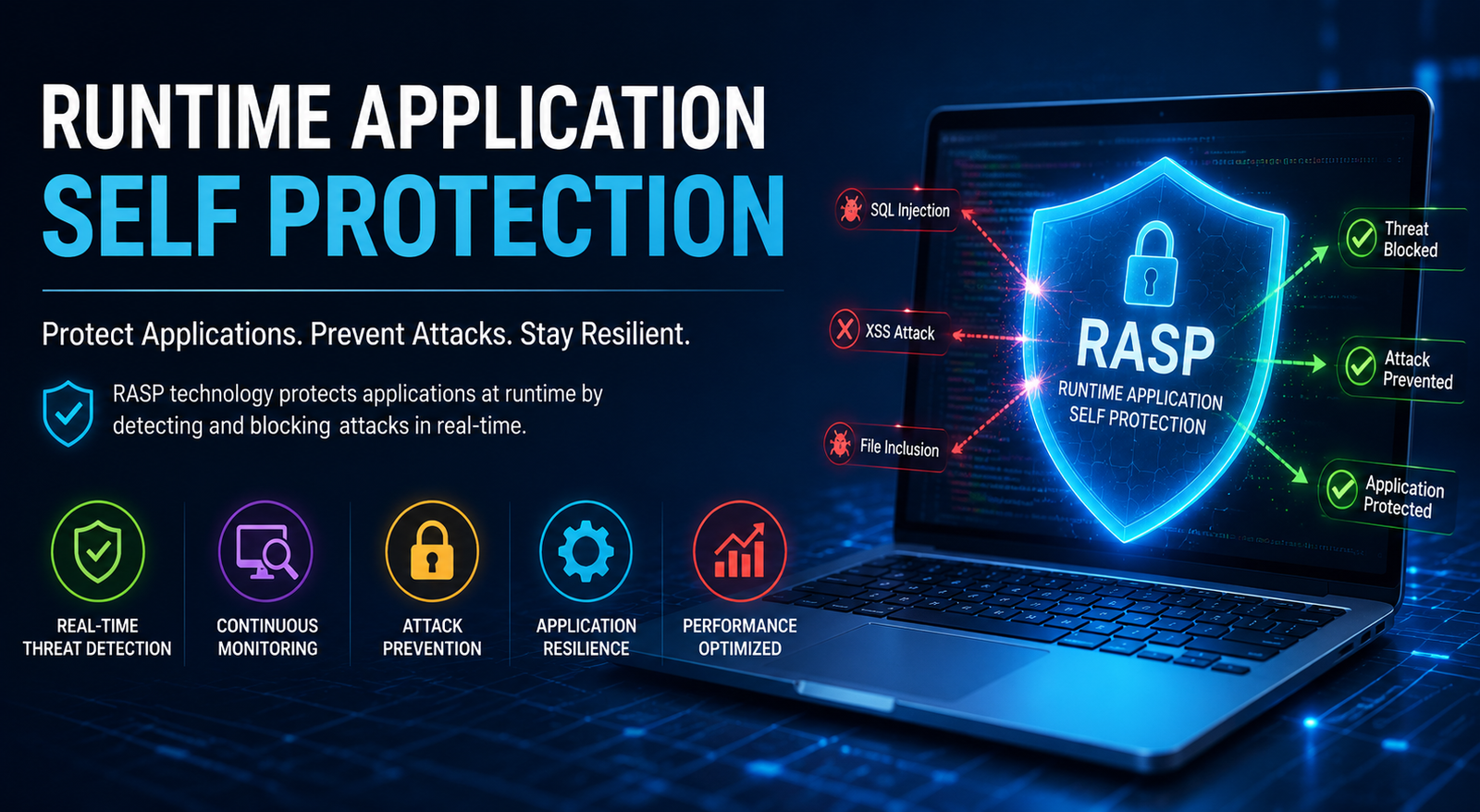
Modern applications face constant security threats after deployment. Traditional security solutions such as firewalls and vulnerability scanners help identify risks, but they often cannot understand what is happening inside an application while it is running. This is where runtime application self protection (RASP) becomes important.
Runtime Application Self Protection allows applications to monitor their own behavior during execution, detect suspicious activities, and automatically respond to attacks. Instead of relying only on external security layers, RASP adds protection directly inside the application environment.
As organizations move toward cloud applications, APIs, and microservices, runtime security has become a critical part of modern application security strategies. RASP helps protect against threats such as SQL injection, cross-site scripting, remote code execution, and unauthorized access attempts.
This guide explains what runtime application self protection is, how it works, its benefits, limitations, RASP vs WAF differences, implementation methods, and the best RASP solutions available today.
What Is Runtime Application Self Protection (RASP)?
Runtime Application Self Protection is a security technology that integrates directly into an application to monitor its behavior while it is running. It analyzes application activity, identifies malicious actions, and can automatically block attacks before they cause damage.
Unlike traditional security tools that operate outside the application, RASP works from inside the application environment. This allows it to understand application logic, user behavior, and the context behind requests.
For example, a traditional firewall may detect a suspicious request pattern, but RASP can determine whether that request is actually dangerous based on how the application processes it.
A runtime application self protection solution typically provides:
Real-time threat monitoring
Application behavior analysis
Attack detection
Automated response actions
Security event reporting
RASP is commonly used in enterprise applications, banking platforms, healthcare systems, SaaS products, and other environments where application security is critical.
How Does Runtime Application Self Protection Work?
RASP works by embedding security capabilities directly into an application's runtime environment. It continuously monitors application execution and evaluates requests, data flows, and user actions.
The process generally involves three main stages.
Application Instrumentation
The first step is integrating the RASP security layer into the application. This can happen through agents, libraries, or runtime monitoring components.
The security agent observes important application functions, including:
Database queries
User inputs
API requests
Authentication processes
File operations
This allows RASP to understand normal application behavior and identify unusual activities.
Threat Detection and Analysis
After integration, RASP continuously analyzes application activity. It uses security rules, behavioral analysis, and contextual information to identify attacks.
For example, if an attacker attempts SQL injection, RASP does not only examine the input. It also checks:
Which application function is being accessed
Whether the database action is expected
Whether the user behavior looks suspicious
This deeper understanding helps reduce false alerts.
Automated Security Response
When RASP detects malicious behavior, it can automatically take action.
Possible responses include:
Blocking the malicious request
Ending a suspicious session
Preventing unauthorized data access
Creating security alerts
Sending information to monitoring platforms
This real-time response capability makes RASP different from many traditional security solutions.
Key Components of a RASP Security Solution
A complete RASP solution usually includes multiple components working together.
These components allow security teams to gain visibility into application behavior while maintaining protection against active threats.
Why Is Runtime Application Self Protection Important?
Applications are becoming the primary target for cybercriminals because they contain valuable data and business logic.
Modern attacks often bypass traditional security controls by targeting application vulnerabilities directly. A vulnerability scanner may discover a weakness, but it cannot always protect the application while attackers are actively exploiting it.
Runtime application self protection provides an additional security layer by protecting applications during execution.
Key reasons organizations adopt RASP include:
Protection Against Advanced Application Attacks
RASP helps detect attacks that target application logic rather than only network traffic.
Examples include:
SQL injection
Cross-site scripting
Command injection
Remote code execution
API abuse
Better Visibility Into Application Behavior
Security teams often lack insight into what happens inside applications after deployment.
RASP provides information about:
User actions
Application processes
Attack attempts
Runtime vulnerabilities
Support for Modern Development Practices
Organizations using DevOps and DevSecOps require security solutions that work throughout the application lifecycle.
RASP helps bridge the gap between development and security teams by providing protection after deployment.
Common Threats RASP Can Detect and Prevent
Runtime application self protection can defend against various application-layer attacks.
Runtime Application Self Protection Example
Consider an online banking application.
An attacker sends a specially crafted request attempting to extract customer database information through SQL injection.
Without runtime protection, the request may reach the database layer before detection.
With RASP enabled:
The application receives the request.
RASP analyzes the input and application context.
The system identifies abnormal database behavior.
The malicious request is blocked.
Security teams receive an alert.
This is a practical runtime application self protection example showing how RASP protects applications while they are actively running.
Runtime Application Self Protection Architecture Explained
A RASP architecture usually operates between the application and the security monitoring environment.
The basic flow looks like this:
User Request → Application → RASP Security Layer → Threat Analysis → Allow / Block / Alert
The RASP layer continuously monitors:
Application code execution
Data movement
User behavior
System interactions
For enterprise environments, RASP can also integrate with:
SIEM platforms
Security monitoring tools
Incident response systems
This allows security teams to combine runtime protection with broader cybersecurity operations.
Benefits of Runtime Application Self Protection
Runtime application self protection provides organizations with an additional security layer that protects applications while they are running. Unlike traditional security solutions that mainly identify vulnerabilities before deployment, RASP focuses on detecting and responding to threats during application execution.
Real-Time Threat Detection
One of the biggest advantages of RASP is its ability to identify and respond to threats instantly. Since RASP operates inside the application environment, it can analyze requests, user behavior, and application processes in real time.
For example, if an attacker attempts SQL injection or unauthorized API access, RASP can detect suspicious activity and block the request before it impacts the application.
Protection Against Unknown Attacks
Traditional security tools often depend on predefined signatures and known attack patterns. However, cybercriminals constantly develop new techniques to bypass security controls.
RASP uses application context and behavioral analysis to identify abnormal activities, making it useful against advanced and unknown threats.
Reduced Security Gaps
Even after security testing, applications may contain vulnerabilities that attackers can exploit. Runtime application self protection helps reduce these security gaps by providing protection after deployment.
This is especially useful for:
Legacy applications
Enterprise software
Frequently updated applications
Cloud-based platforms
Improved Application Visibility
RASP gives security teams deeper insight into application behavior by monitoring activities during runtime.
Organizations can understand:
Which application functions are being targeted
Where attacks are coming from
How attackers interact with applications
Which vulnerabilities are actively exploited
Support for Compliance Requirements
Many industries require strong application security practices to protect sensitive information.
RASP can support compliance efforts related to:
PCI DSS
HIPAA
SOC 2
ISO 27001
By monitoring application activity and detecting threats, RASP helps organizations maintain stronger security controls.
Limitations and Challenges of Runtime Application Self Protection
Although RASP provides powerful runtime security capabilities, organizations should understand its limitations before implementation.
Performance Impact
Because RASP works during application execution, it may introduce additional processing requirements.
Possible challenges include:
Increased CPU usage
Additional memory consumption
Minor application latency
Proper configuration, testing, and optimization can reduce performance issues.
Implementation Complexity
Deploying a RASP solution requires technical planning and coordination between development and security teams.
Organizations need to consider:
Application compatibility
Programming language support
Deployment method
Security policy configuration
False Positives
Like other cybersecurity technologies, RASP may sometimes identify legitimate activities as suspicious.
Security teams need to continuously adjust policies and analyze alerts to maintain accuracy.
RASP Is Not a Complete Security Solution
Runtime application self protection should be used as part of a layered security strategy.
It works best alongside:
Web Application Firewall (WAF)
Static Application Security Testing (SAST)
Dynamic Application Security Testing (DAST)
Penetration testing
Security monitoring tools
RASP vs Other Application Security Solutions
Different application security technologies solve different security challenges. Understanding their differences helps organizations choose the right protection strategy.
RASP vs WAF: Understanding the Difference
One of the most common comparisons in application security is RASP vs WAF.
A Web Application Firewall protects applications by filtering incoming traffic before it reaches the application. It mainly focuses on detecting malicious requests based on predefined rules and attack patterns.
RASP works differently because it operates inside the application itself.
A WAF can identify:
Suspicious traffic patterns
Malicious requests
Known attack signatures
RASP can understand:
Application logic
Runtime behavior
User activity
Internal application processes
For example, a WAF may detect a suspicious database request, but RASP can determine whether that request matches normal application behavior before allowing execution.
Many enterprises use both solutions together for stronger protection.
Runtime Application Self Protection in Cloud-Native Applications
Modern applications are increasingly built using cloud infrastructure, APIs, containers, and microservices. These environments require advanced runtime security approaches.
RASP for Kubernetes and Containers
Container-based applications can create additional security challenges because workloads are distributed across multiple environments.
RASP helps protect:
Containerized applications
Microservices
Cloud workloads
It provides visibility into application behavior even when applications are running in dynamic environments.
RASP for API Security
APIs are frequently targeted because they provide direct access to application functionality and sensitive data.
Runtime application self protection helps detect:
API abuse
Unauthorized requests
Suspicious data access
Authentication attacks
RASP in DevSecOps
DevSecOps focuses on integrating security throughout the software development lifecycle.
RASP supports DevSecOps by providing runtime protection after applications are deployed.
It can integrate with:
CI/CD pipelines
Security monitoring platforms
Incident response systems
How to Implement Runtime Application Self Protection
Organizations should follow a structured approach when deploying RASP.
Identify Critical Applications
The first step is identifying applications that require additional protection.
Examples include:
Banking applications
Healthcare platforms
SaaS products
Customer portals
Select the Right RASP Solution
Organizations should evaluate solutions based on:
Programming language compatibility
Cloud support
Integration options
Monitoring capabilities
Performance impact
Deploy the RASP Protection Layer
After selecting a solution, security teams install the RASP agent or runtime component into the application environment.
Testing should be completed before full production deployment.
Configure Security Policies
Security teams should define:
Detection rules
Blocking actions
Alert settings
Monitoring requirements
Monitor and Optimize
Continuous monitoring helps improve detection accuracy and reduce unnecessary alerts.
Best Runtime Application Self Protection Solutions
Different RASP solutions are designed for different organizational requirements.
Runtime Application Self Protection Open Source Options
Developers and security researchers can explore runtime application self protection open source projects to understand runtime security concepts.
Open-source RASP solutions can help organizations:
Test security approaches
Learn runtime protection techniques
Build customized security solutions
However, enterprise environments often prefer commercial RASP solutions because they provide:
Vendor support
Advanced analytics
Compliance features
Enterprise integrations
Who Should Use RASP?
Runtime application self protection is valuable for organizations that operate applications containing sensitive information.
Enterprises
Large organizations use RASP to protect:
Financial systems
Customer applications
Enterprise software
Developers
Development teams can use RASP to improve application security after deployment.
Security Teams
Security professionals use RASP for:
Threat monitoring
Runtime visibility
Incident investigation
Future of Runtime Application Self Protection
The future of RASP is connected with the growth of cloud computing, artificial intelligence, and automated cybersecurity.
Future improvements may include:
AI-powered threat detection
Automated response systems
Better API protection
Cloud-native security improvements
Zero Trust integration
As applications become more complex, runtime security will become an essential part of modern cybersecurity strategies.
Conclusion
Runtime application self protection provides real-time security by allowing applications to detect and respond to threats while they are running. It offers deeper visibility than many traditional security solutions because it understands application behavior and context.
Although RASP does not replace other security technologies, it adds an important protection layer for modern applications, APIs, and cloud environments. Organizations that combine RASP with DevSecOps practices and layered security strategies can build stronger defenses against evolving cyber threats.
Frequently Asked Questions About Runtime Application Self Protection
What is runtime application self protection?
Runtime application self protection is a security technology that protects applications during execution by monitoring behavior, detecting threats, and automatically responding to attacks.
How does RASP protect applications?
RASP integrates into applications and analyzes runtime activities to identify malicious requests, abnormal behavior, and security threats.
What is the difference between RASP and WAF?
RASP works inside the application environment, while WAF protects applications by filtering external traffic before requests reach the application.
Can RASP prevent zero-day attacks?
RASP can help detect unknown attacks by analyzing application behavior instead of relying only on predefined signatures.
Are there runtime application self protection open source solutions?
Yes, several open-source projects allow developers to explore runtime protection concepts, although enterprise solutions usually provide more advanced features.
Is RASP enough for complete application security?
No. RASP should be combined with other security practices such as secure coding, vulnerability testing, WAF, and monitoring systems.
Leave a Reply