

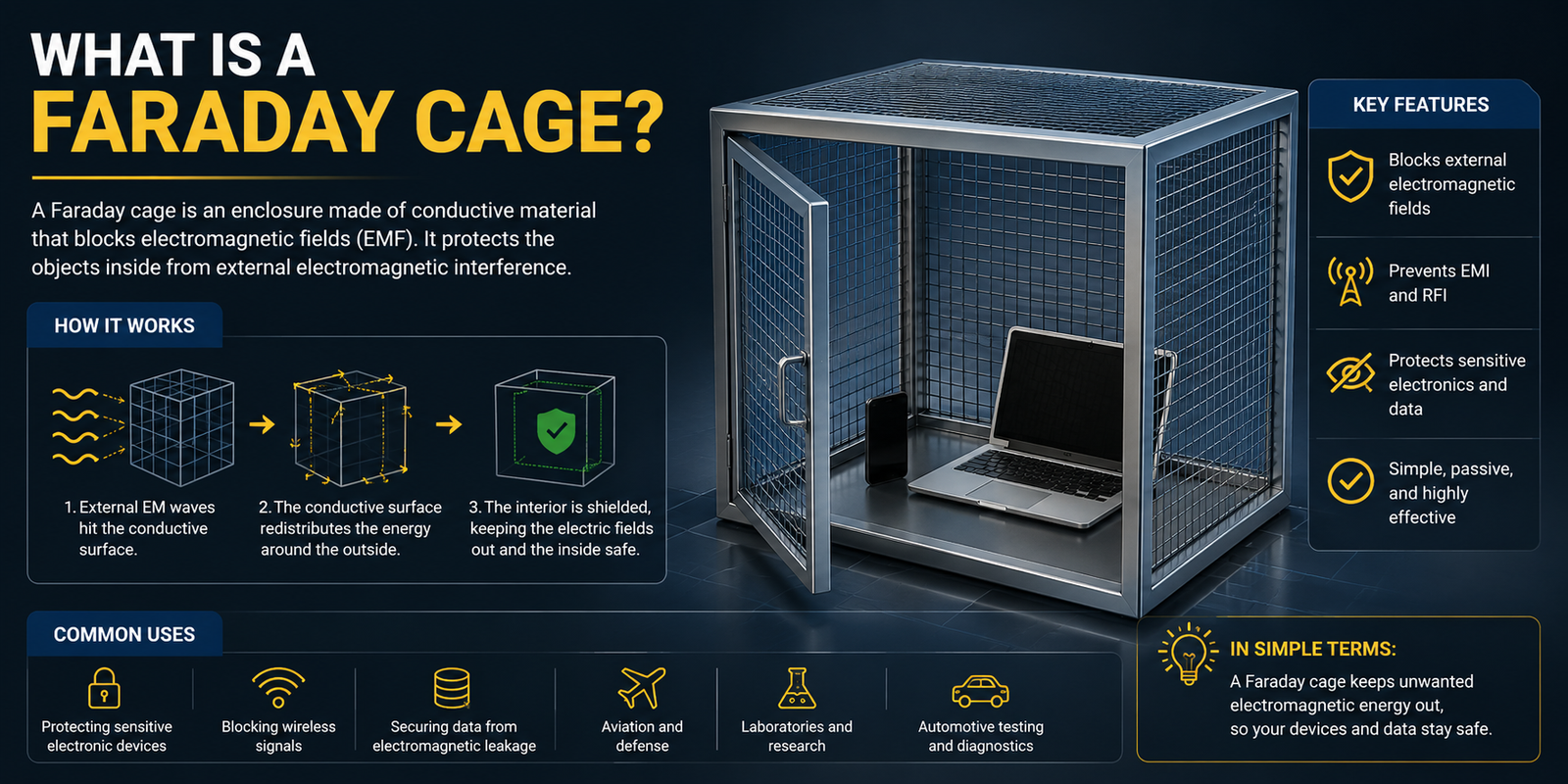
A Faraday cage is an enclosure made from conductive material that reduces the electromagnetic energy reaching the space or objects inside it. Depending on its design, it can weaken radio signals, Wi-Fi, Bluetooth, cellular signals, and other forms of electromagnetic interference.
Faraday cages are not just laboratory equipment. They appear in everyday technology, including microwave ovens, vehicles, shielded electronics, security facilities, and Faraday bags used to isolate devices from wireless signals.
But a common misconception is that any metal container automatically blocks every electromagnetic signal. In reality, the material, frequency, openings, seams, thickness, and overall construction all affect shielding performance.
What Is a Faraday Cage and How Does It Work?
A Faraday cage works by using a conductive enclosure to redistribute electrical charges in response to an external electric field or electromagnetic energy. The redistribution creates a shielding effect that reduces the field inside the enclosure.
Think of it as a protective shell around an object. When electromagnetic energy reaches the conductive surface, the electrons in that material respond to the incoming field. Under suitable conditions, this interaction reduces the amount of electromagnetic energy that penetrates into the enclosed space.
A Faraday cage can be completely solid or made from conductive mesh. The important factor is not simply whether the enclosure is made from metal, but whether its construction provides effective shielding for the particular frequency being considered.
The Science Behind a Faraday Cage
Electric Fields and Conductive Materials
Conductors such as copper, aluminum, and steel contain electrons that can move through the material. When an external electric field interacts with a conductor, these charges redistribute across its surface.
This redistribution changes the electric field around the conductor and can greatly reduce the electric field inside a closed conductive enclosure. This is one of the fundamental principles behind Faraday shielding.
Electromagnetic Waves and Frequency
Radio, Wi-Fi, Bluetooth, and cellular communications use electromagnetic waves at different frequencies. A Faraday cage's effectiveness therefore depends partly on the frequency it needs to attenuate.
Frequency is closely related to wavelength. This becomes especially important when the enclosure contains openings or mesh. A design that works well for one frequency may not provide the same level of shielding at another.
For this reason, professional electromagnetic shielding is designed around the specific frequencies, field strengths, materials, and performance requirements involved.
What Are Faraday Cages Made Of?
Faraday cages can be constructed from many conductive materials. Common choices include copper, aluminum, steel, and conductive metal mesh.
The best material depends on the application. Copper offers excellent electrical conductivity, while aluminum is lightweight and commonly used for shielding. Steel provides mechanical strength and is frequently used for larger structures and equipment enclosures.
Material selection is only one part of the equation. A highly conductive material can still perform poorly if the enclosure has large gaps, poorly connected seams, or openings that allow electromagnetic energy to enter.
What Is a Faraday Cage Used For?
The main purpose of a Faraday cage is electromagnetic shielding. It can be used to protect sensitive equipment from electromagnetic interference or to prevent signals from escaping or entering a particular area.
Common applications include:
Protecting sensitive electronic equipment
Reducing electromagnetic interference
Shielding testing environments
Protecting electronic components from certain external fields
Isolating wireless devices from radio signals
Creating controlled environments for scientific equipment
Supporting ESD and electronics-protection applications
A small Faraday bag uses the same general shielding principle on a much smaller scale. For example, a properly designed signal-blocking bag can reduce wireless communication between a device and external networks.
What Can a Faraday Cage Block?
A properly designed Faraday cage can significantly reduce certain electromagnetic signals, but it is inaccurate to say that every cage blocks everything.
The distinction is important. Electromagnetic shielding is frequency-dependent, and ordinary conductive materials are not equally effective against every type of electromagnetic or magnetic field.
What Makes a Faraday Cage Effective?
Several factors determine how well a Faraday cage performs.
Conductive Material
The enclosure needs electrically conductive material suitable for the intended shielding application. Copper, aluminum, and steel are common choices.
Frequency
Shielding effectiveness varies with frequency. A cage designed for radio-frequency signals may not provide the same protection against static or low-frequency magnetic fields.
Thickness
Material thickness can affect attenuation, but thicker metal does not automatically mean a better Faraday cage. Frequency, conductivity, enclosure geometry, and other design factors also matter.
Gaps and Seams
Small openings can become important pathways for electromagnetic energy. Poorly connected seams, doors, vents, windows, and other penetrations can reduce shielding effectiveness.
Mesh Size
A solid sheet is not always necessary. Conductive mesh can provide shielding while allowing light and airflow. However, the opening dimensions must be appropriate for the frequencies being shielded.
This is why a metal mesh can work effectively in applications such as microwave oven doors.
Does Mesh Size Matter in a Faraday Cage?
Yes. Mesh size can have a major effect on shielding performance.
A conductive mesh contains openings, so electromagnetic energy can potentially pass through those openings. The relationship between the opening size and the wavelength of the signal is therefore important.
A familiar example is a microwave oven door. Its perforated metal screen allows you to see through the door while helping contain the microwave energy generated inside.
The same principle is used in other shielding applications where engineers need both electromagnetic protection and ventilation or visibility.
Does a Faraday Cage Need to Be Grounded?
Not necessarily. Grounding and electromagnetic shielding are related concepts, but they are not the same thing.
A closed conductive enclosure can provide electromagnetic shielding without being connected to ground. However, grounding may be important for electrical safety, static-charge dissipation, or specific industrial and engineering applications.
For example, an ESD-protection system may have grounding requirements that are different from those of a simple demonstration enclosure.
The correct approach is to consider what the enclosure is designed to accomplish rather than assuming that every Faraday cage must be grounded.
Common Faraday Cage Examples
Microwave Oven
A microwave oven is one of the most recognizable examples. Its metal enclosure and conductive mesh in the door help contain microwave energy.
Car
A vehicle's conductive body can provide significant protection from certain external electrical effects. This is why cars are commonly discussed as practical examples of Faraday-cage behavior.
However, a car is not a perfect laboratory Faraday cage. Its windows, seams, electronics, and construction affect its actual shielding characteristics.
MRI Rooms
MRI facilities can use specialized electromagnetic shielding to reduce unwanted radio-frequency interference that could affect sensitive imaging equipment.
Electronics Enclosures
Metal housings around electronic equipment can reduce electromagnetic interference entering or leaving the device.
ESD Packaging
Specialized shielding packaging can help protect sensitive electronic components from electrostatic and electromagnetic hazards. This is where Faraday-cage principles overlap with practical electronics protection.
Is a Car a Faraday Cage?
A car can behave similarly to a Faraday cage because its conductive body provides a path for electrical charge around the exterior rather than through the occupants.
This is particularly relevant when discussing lightning. The vehicle's conductive exterior can help direct electrical current around the passenger compartment.
Still, it is better to say that a vehicle exhibits Faraday-cage behavior rather than claiming every car is a perfect Faraday cage. Modern vehicles contain many openings, electronics, insulating materials, and other features that influence electromagnetic behavior.
Can a Faraday Cage Block Wi-Fi, Bluetooth, and Cell Signals?
Wi-Fi
A sufficiently effective conductive enclosure can greatly reduce Wi-Fi signals. If a device inside a well-designed enclosure can no longer communicate reliably with a wireless router, the enclosure is providing meaningful attenuation at those frequencies.
Bluetooth
Bluetooth also relies on radio-frequency communication, so conductive shielding can reduce its signal strength. The result depends on the quality and continuity of the enclosure.
Cell Phone Signals
A Faraday cage or Faraday bag can reduce cellular signals when it is designed to attenuate the relevant frequencies.
A useful experiment is to place a phone inside a properly closed shielding enclosure and attempt to call it. You can also compare Wi-Fi connectivity before and after placing the device inside.
However, passing a phone test does not prove that the enclosure blocks every frequency. It only demonstrates how the enclosure behaves under that particular test condition.
Can a Faraday Cage Protect Against an EMP?
A properly engineered electromagnetic shield can potentially reduce the effects of certain electromagnetic pulses, but not every metal container should be considered EMP-proof.
An EMP can contain energy across different frequency ranges, and shielding effectiveness depends on the pulse characteristics, enclosure construction, seams, openings, cables, grounding arrangements, and other factors.
For serious applications, EMP shielding needs to be engineered and tested against the relevant threat rather than assumed from the presence of a metal enclosure.
Faraday Cage vs. Faraday Shield
The terms Faraday cage and Faraday shield are closely related, although they can be used in slightly different engineering contexts.
In everyday explanations, the terms are often used interchangeably. In technical contexts, “shield” can refer more broadly to conductive structures that reduce electromagnetic interference.
Faraday Cage vs. Magnetic Shielding
One of the most important distinctions is that electromagnetic shielding is not the same as magnetic shielding.
Conductive materials are very useful for reducing many electric fields and higher-frequency electromagnetic signals. Static or low-frequency magnetic fields can be much more difficult to shield using ordinary metals.
Specialized magnetic shielding may require materials and designs specifically selected for the magnetic field involved.
Therefore, a Faraday cage should not automatically be described as protection against every magnetic field.
How to Make a Simple Faraday Cage
For a basic educational experiment, you can create a small conductive enclosure around an electronic device.
A simple demonstration might use a conductive metal container with a properly fitted lid. The goal is to create as continuous an enclosure as practical, minimizing large gaps.
You can then test whether a phone can maintain a cellular, Wi-Fi, or Bluetooth connection inside the enclosure.
The experiment demonstrates an important principle: shielding performance depends on enclosure design, not simply the presence of metal.
For professional applications, however, signal-strength measurements and calibrated electromagnetic shielding tests are more meaningful than a simple phone test.
Common Myths About Faraday Cages
Myth 1: Every Metal Box Is a Perfect Faraday Cage
False. Gaps, seams, openings, cables, and construction quality can dramatically affect performance.
Myth 2: A Faraday Cage Always Needs Grounding
False. Grounding may be required for particular safety or charge-control purposes, but electromagnetic shielding itself does not universally require grounding.
Myth 3: A Faraday Cage Blocks Every Magnetic Field
False. Conductive electromagnetic shielding and magnetic shielding are not identical.
Myth 4: Thicker Metal Always Means Better Shielding
Not necessarily. Frequency, conductivity, geometry, gaps, and other factors influence shielding effectiveness.
Myth 5: If It Blocks a Phone, It Blocks Everything
False. Different signals use different frequencies, so successful phone isolation does not prove universal shielding.
Conclusion
A Faraday cage is a conductive enclosure designed to reduce electromagnetic energy inside a protected space. Its basic principle is straightforward, but its real-world performance depends on much more than simply surrounding an object with metal.
Material, frequency, wavelength, thickness, mesh size, seams, openings, and enclosure continuity all influence shielding effectiveness. Everyday examples such as microwave ovens, vehicles, electronics enclosures, and specialized rooms show how useful the principle can be.
The most important takeaway is that a Faraday cage is not a universal electromagnetic barrier. Understanding what it is designed to shield—and how well its construction matches that requirement—is the key to using Faraday shielding effectively.
Frequently Asked Questions
What is a Faraday cage in simple terms?
A Faraday cage is a conductive enclosure that reduces electromagnetic energy reaching the space or object inside it. Its effectiveness depends on its construction and the frequency being shielded.
What is a Faraday cage used for?
A Faraday cage is used for electromagnetic shielding, protecting sensitive electronics, reducing interference, isolating wireless signals, and creating controlled environments for certain scientific and industrial applications.
Does aluminum foil work as a Faraday cage?
Aluminum foil can contribute to electromagnetic shielding when it forms a sufficiently continuous enclosure. However, gaps, seams, multiple layers, and the target frequency all affect how effective the setup will be.
Can a Faraday cage block Wi-Fi?
Yes. A properly designed conductive enclosure can significantly reduce Wi-Fi signals. The amount of attenuation depends on the enclosure's materials, construction, openings, and the Wi-Fi frequency involved.
Can a Faraday cage block cell phone signals?
Yes, an effective Faraday cage or Faraday bag can reduce cellular signals. However, shielding performance varies by frequency and enclosure design.
Does a Faraday cage need to be grounded?
No, not universally. Grounding can be important for electrical safety, static-charge control, or specialized applications, but it is not an automatic requirement for electromagnetic shielding.
Can a Faraday cage protect against an EMP?
A properly engineered shield can reduce exposure to certain electromagnetic pulse energy, but an ordinary metal box should not automatically be considered EMP protection. Effective protection depends on the pulse characteristics and shielding design.
Leave a Reply