

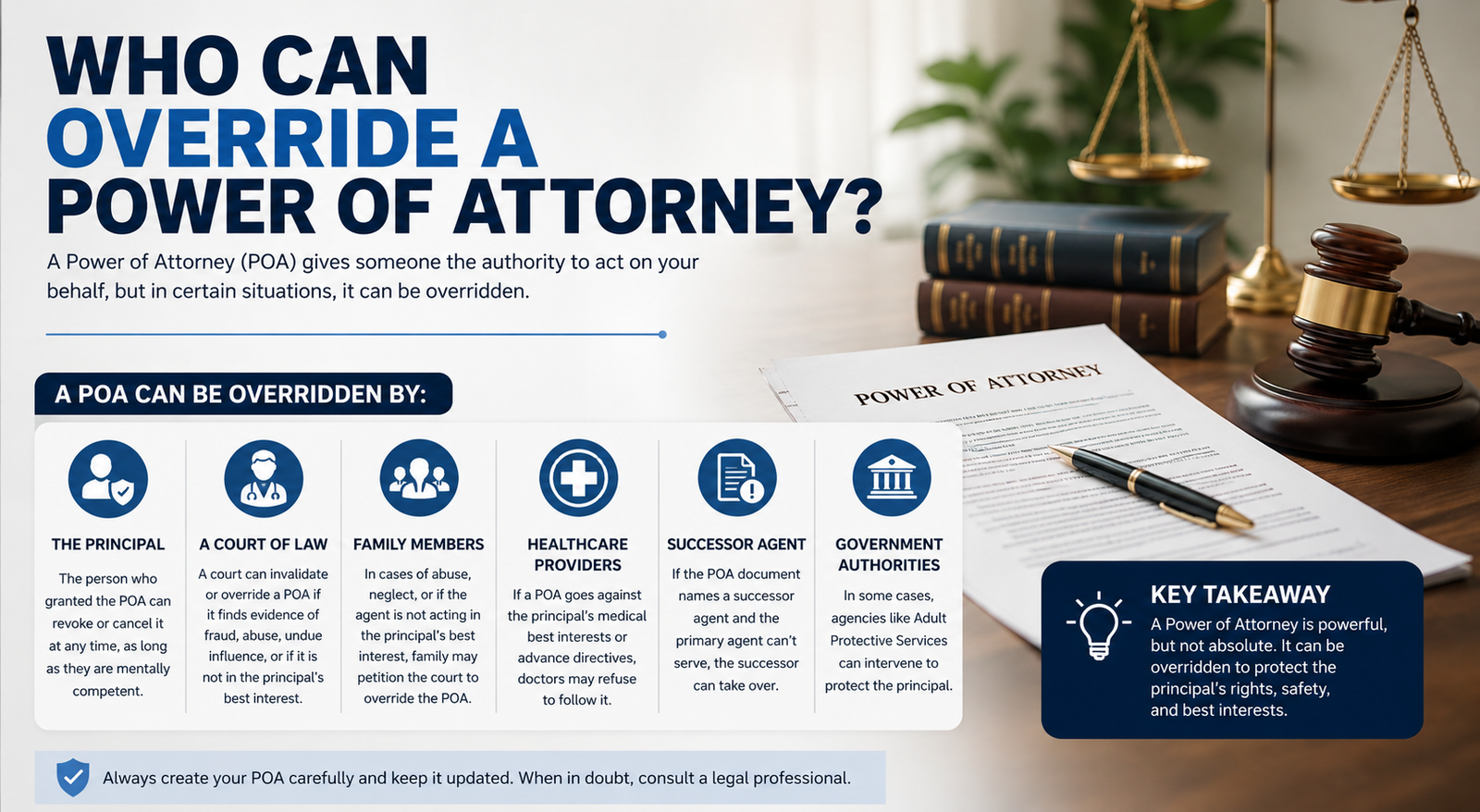
A power of attorney (POA) is one of the most important legal documents a person can create. It allows someone you trust, known as an agent or attorney-in-fact, to make financial, legal, or medical decisions on your behalf if you are unable to do so yourself. While a POA offers peace of mind, it can also raise questions when family members disagree with the agent's decisions or suspect abuse.
One of the most common questions is who can override a power of attorney. The answer is more complex than many people expect. In most situations, no family member, friend, or relative can simply cancel or ignore a valid POA. However, there are specific circumstances in which the principal, a court, or a court-appointed guardian may legally revoke or replace a power of attorney.
This guide explains who has the authority to override a POA, when legal intervention is possible, how the revocation process works, and what options are available if you believe a power of attorney is being misused.
Quick Answer: Who Can Override a Power of Attorney?
In most cases, only the principal—the person who created the power of attorney—can revoke or change it while they are mentally competent. If the principal no longer has the mental capacity to make decisions, a court may intervene and appoint a guardian or conservator when there is evidence of fraud, abuse, undue influence, or misconduct by the agent.
Simply being a spouse, adult child, sibling, or next of kin does not automatically give someone the authority to override a valid power of attorney.
What Is a Power of Attorney?
A power of attorney is a legal document that authorises one person to act on behalf of another. The person granting authority is called the principal, while the individual receiving that authority is known as the agent or attorney-in-fact.
Depending on the document, the agent may handle financial transactions, sign legal documents, manage property, or make healthcare decisions.
How Does a Power of Attorney Work?
Once a POA becomes effective, the agent must act in the principal's best interests. This includes managing assets responsibly, avoiding conflicts of interest, and keeping accurate records of important decisions.
The powers granted depend on the wording of the document. Some POAs provide broad authority, while others are limited to a specific task or period.
Principal vs Agent
Understanding each person's role helps avoid confusion.
The agent has a fiduciary duty, meaning they must always act honestly, responsibly, and in the principal's best interests.
Types of Power of Attorney
Not all powers of attorney are the same. Different types serve different purposes.
Understanding the type of POA involved is essential because it affects how and when authority can be exercised or challenged.
Can Anyone Override a Power of Attorney?
The simple answer is no.
Many people assume that close relatives automatically have greater legal authority than an appointed agent. In reality, family relationships alone do not override a legally executed POA.
For example:
A spouse cannot automatically cancel the agent's authority.
Adult children cannot remove the agent simply because they disagree with financial decisions.
Siblings have no automatic right to replace the agent.
Friends or caregivers cannot revoke the document.
Instead, any challenge must usually be based on valid legal grounds and, in many cases, require court involvement.
Who Has the Legal Authority to Override a Power of Attorney?
Only certain individuals or institutions may legally override or replace a power of attorney under specific circumstances.
The Principal
As long as the principal remains mentally competent, they can revoke or replace a power of attorney at any time.
This process is known as the revocation of power of attorney. The principal generally signs a written revocation, notifies the current agent, and informs any banks, healthcare providers, or organisations that relied on the previous POA.
Many people ask, "Can you change power of attorney without consent?" In most cases, the principal does not need the agent's permission to revoke or replace a POA while they still have legal capacity.
A Judge
If serious concerns arise, a judge may determine that the existing POA is invalid or should no longer be used.
Examples include:
Fraud during signing
Forgery
Financial exploitation
Elder abuse
Misuse of assets
Breach of fiduciary duty
The court reviews the available evidence before making a decision.
Court-Appointed Guardian or Conservator
If the principal becomes incapacitated and the court determines that the current arrangement no longer protects their interests, it may appoint a guardian or conservator.
Depending on state law and the court's order, the guardian's authority may replace or limit the powers previously granted to the agent.
Can Family Members Challenge a Power of Attorney?
Yes—but challenging a POA is very different from automatically overriding one.
Family members can petition the court if they believe the agent is acting improperly or if the document was created under unlawful circumstances.
Can a Family Member Revoke a Power of Attorney?
One of the most frequently searched questions is "Can a family member revoke a power of attorney?"
Generally, the answer is no.
A relative cannot revoke a valid POA simply because they disagree with the agent's decisions. However, they may ask a court to review the situation if there is evidence of wrongdoing.
Similarly, people often ask whether a family member can revoke a power of attorney online. Legal revocation typically requires proper legal procedures and documentation rather than completing an online form. While some jurisdictions may allow electronic filing of court documents, the legal requirements still apply.
Does Next of Kin Override Power of Attorney?
No.
Another common misconception is that the next of kin automatically has greater authority than the appointed agent.
The answer to "Does next of kin override power of attorney?" is generally no. Being the closest living relative does not invalidate a legally executed POA.
Only the principal or a court acting under applicable law may revoke or replace the document.
Can a Spouse Override a Power of Attorney?
Marriage alone does not cancel or replace a valid POA.
Even if a spouse disagrees with the agent's actions, they must present evidence to the court if they believe misconduct has occurred.
Can Adult Children or Siblings Challenge a POA?
Yes.
Children or siblings who suspect abuse, fraud, or financial exploitation may ask a court to investigate. If sufficient evidence exists, the judge may remove the current agent or appoint a guardian.
Legal Reasons a Court May Invalidate a Power of Attorney
Courts generally require clear legal grounds before interfering with a valid power of attorney.
Common reasons include:
Fraud
If the document was created using false information or deception, it may be declared invalid.
Forgery
A forged signature or falsified document can result in immediate legal action.
Undue Influence
Sometimes an elderly or vulnerable person is pressured into signing documents against their wishes.
For example, a caregiver may isolate the principal from family members and convince them to sign a new POA that benefits the caregiver financially.
Mental Incapacity
A power of attorney may be challenged if the principal lacked the mental capacity to understand what they were signing.
Medical records and expert testimony often play a significant role in these cases.
Financial Abuse
An agent must always act in the principal's best interests.
Warning signs include:
Unexplained withdrawals
Missing bank accounts
Unauthorised property transfers
Personal use of the principal's funds
Refusal to provide financial records
These situations often prompt court investigations.
Signs That a Power of Attorney May Be Abused
Family members should pay attention to warning signs that suggest an agent may be misusing their authority.
Some common indicators include:
Sudden changes in financial accounts
Large gifts to the agent
Missing valuables
Isolation of the principal from relatives
Secretive financial decisions
Unexpected changes to estate plans
Refusal to share account records
Unpaid bills despite sufficient assets
Recognising these warning signs early can help protect the principal from financial exploitation and other forms of abuse.
How to Challenge a Power of Attorney in Court
If you believe an agent is acting improperly, you may need to ask the court to review the power of attorney.
The process generally involves the following steps:
Gather financial records, medical reports, and other supporting evidence.
Consult an estate planning or elder law attorney.
File a petition with the appropriate court.
Notify interested parties.
Attend court hearings.
Present evidence and witness testimony.
Wait for the judge's decision.
Each case depends on the available evidence and the laws of the relevant jurisdiction.
What Evidence Is Needed to Challenge a Power of Attorney?
Successfully challenging a POA usually requires credible evidence rather than personal disagreements.
Useful evidence may include:
Medical records showing incapacity
Bank statements revealing suspicious transactions
Witness testimony
Emails or written communications
Property records
Financial audits
Expert medical opinions
Copies of the original power of attorney document
Strong documentation significantly improves the likelihood that the court will carefully examine the agent's conduct.
What Happens After a Power of Attorney Is Revoked?
Once a power of attorney has been legally revoked, the agent immediately loses the authority granted under the document. Any banks, healthcare providers, government agencies, or other organisations that relied on the previous POA should be notified to prevent unauthorised decisions.
Depending on the situation, one of the following may happen:
The principal signs a new power of attorney appointing a different agent.
A court appoints a guardian or conservator if the principal lacks mental capacity.
Financial institutions update their records with the new legal documentation.
Healthcare providers begin following the instructions of the newly appointed decision-maker.
If no replacement POA exists and the principal becomes unable to manage their affairs, court intervention may be necessary.
Can Banks, Hospitals, or Nursing Homes Refuse a Power of Attorney?
Many people believe these organisations can override a POA, but that is not entirely accurate.
Banks
Banks may refuse to accept a power of attorney if:
The document appears outdated.
Required signatures or notarisation are missing.
They suspect fraud or financial abuse.
State legal requirements have not been met.
A refusal to accept the document does not revoke it. Instead, the institution may request additional verification before allowing the agent to act.
Hospitals
Hospitals generally honour a valid medical power of attorney. However, they may decline to follow it if:
The document is invalid.
The principal is still capable of making healthcare decisions.
Another legal document supersedes it.
Nursing Homes
Nursing homes often review POA documents before accepting instructions from an agent. If concerns arise regarding abuse or validity, they may involve legal counsel or Adult Protective Services.
State Laws Can Affect Who Can Override a Power of Attorney
Power of attorney laws are not identical across every jurisdiction. Each state has its own legal requirements regarding:
Witnesses
Notarisation
Revocation procedures
Court authority
Guardian appointments
Acceptance of out-of-state POAs
Because of these differences, it is important to review your state's laws or consult a qualified attorney before taking legal action.
How to Change a Power of Attorney
Circumstances change over time. Relationships evolve, agents relocate, or someone may no longer be the right choice.
How to Change Power of Attorney From One Person to Another
If the principal still has legal capacity, changing a POA is usually straightforward.
The typical process includes:
Revoke the existing POA in writing.
Notify the current agent.
Prepare a new power of attorney.
Sign the new document according to state law.
Provide copies to relevant organisations.
Many people ask how to change power of attorney from one person to another. The answer depends on state requirements, but creating a written revocation followed by a properly executed new POA is generally the recommended approach.
How to Change Power of Attorney for Someone With Dementia
This situation is much more complicated.
If a person with dementia still understands the nature and consequences of signing legal documents, they may be able to revoke or replace an existing POA.
However, if they no longer have legal capacity, they usually cannot change the document themselves.
When people search for how to change power of attorney for someone with dementia, the answer often involves petitioning the court for guardianship or conservatorship rather than simply creating a new POA.
Because dementia affects every individual differently, medical evaluations are frequently required before legal changes can occur.
Do You Need a Lawyer to Revoke Power of Attorney?
Technically, you do not always need a lawyer to revoke power of attorney if the principal is mentally competent and state law requirements are followed.
However, legal assistance is strongly recommended when:
Family members disagree.
Financial abuse is suspected.
Court proceedings are involved.
The principal has dementia or diminished capacity.
Large estates or businesses are affected.
An experienced estate planning or elder law attorney can ensure the revocation complies with applicable laws and reduces the risk of future disputes.
Common Mistakes Families Make During POA Disputes
Power of attorney disputes often become emotionally charged. Avoiding common mistakes can save time, money, and unnecessary conflict.
Common mistakes include:
Assuming relatives automatically have authority.
Waiting too long to report suspected abuse.
Failing to document suspicious financial activity.
Ignoring medical evidence regarding capacity.
Attempting to remove an agent without legal grounds.
Not seeking professional legal advice early.
Understanding the legal process before taking action can prevent costly mistakes.
Real-Life Examples
Example 1: A Competent Parent Revokes a POA
Margaret appointed her eldest son as her financial agent several years ago. After a family disagreement, she decided to appoint her daughter instead.
Because Margaret remained mentally competent, she signed a written revocation and executed a new power of attorney. The previous agent immediately lost authority.
Example 2: Financial Abuse Leads to Court Intervention
Robert's family noticed unusual withdrawals from his bank account after his nephew became his attorney-in-fact.
Bank records showed thousands of pounds in unauthorised transfers for the nephew's personal expenses. The court removed the agent and appointed a guardian to protect Robert's finances.
Example 3: Dementia Creates Legal Challenges
Helen developed advanced dementia several years after signing a POA.
Her family wanted to appoint a different agent, but because Helen no longer had legal capacity, they petitioned the court for guardianship instead of attempting to change the existing document themselves.
How to Prevent Future Power of Attorney Disputes
Proper planning greatly reduces the risk of future disagreements.
Consider these best practices:
Choose someone trustworthy and financially responsible.
Discuss your wishes openly with close family members.
Keep copies of important legal documents.
Review your estate plan regularly.
Update your POA after major life events.
Maintain accurate financial records.
Consult an estate planning attorney when creating or revising legal documents.
These steps help ensure your wishes are respected while protecting your interests.
Comparison Table: Who Can Override a Power of Attorney?
Conclusion
Understanding who can override a power of attorney is essential for protecting both the principal and the appointed agent. While many people assume that spouses, adult children, or other relatives automatically have authority, the law generally provides otherwise. In most cases, only the principal can revoke a valid power of attorney while mentally competent, and courts intervene only when there is evidence of fraud, abuse, incapacity, or other legal concerns.
Whether you are creating, challenging, or revoking a power of attorney, understanding your legal rights and following the correct procedures can prevent disputes and safeguard the principal's interests. Because laws vary by state, consulting a qualified estate planning or elder law attorney is often the best way to ensure your decisions comply with current legal requirements.
Frequently Asked Questions
Can a family member revoke a power of attorney?
Generally, no. Family members cannot revoke a valid POA simply because they disagree with the agent. They must usually ask a court to review the situation if there are valid legal grounds.
Does next of kin override power of attorney?
No. Being the next of kin does not automatically give someone greater authority than a legally appointed agent.
Can you change power of attorney without consent?
If the principal remains mentally competent, they may revoke and replace a POA without the current agent's consent.
Do you need a lawyer to revoke power of attorney?
Not always. A competent principal can often complete the process independently, but legal advice is highly recommended for complicated situations or family disputes.
How do you change power of attorney for someone with dementia?
If the person still has legal capacity, they may create a new POA. If they lack capacity, family members generally need to seek guardianship or conservatorship through the court.
Can a bank refuse a power of attorney?
Yes. Banks may refuse a POA if they believe it is invalid, incomplete, outdated, or potentially fraudulent, but they cannot revoke the document themselves.
Does a power of attorney end after death?
Yes. A power of attorney automatically ends when the principal dies. At that point, the executor or personal representative manages the estate.
Leave a Reply